How Long Consumer Electronics Last Before Landfill
Most phones end up in drawers within two years, worth far less than owners think.
Most gadgets don't die of natural causes. They die of boredom, or worse, they get replaced because someone's aunt gave them a shiny new one for the holidays. The actual hardware failure, the thing everyone pictures when they think "this phone is dead," rarely occurs in time to justify the upgrade. More than half of phone owners hang onto a device for only two years before moving on, and more than half never bother sending the old one off for recycling. Instead, it goes into a drawer, where it will keep the loose change and expired gift cards company for the next decade.
Research on this pattern (the MDPI paper, if you want to sound smart at a dinner party) points to three specific reasons people stash devices instead of selling them: they haven't used the thing long enough to feel like it's really "used," they think it's worth more than it is, and they're nervous about their data walking off with a stranger. All three are reasonable, according to factors identified by an MDPI paper: short usage time, perceived residual value of the old device, and concerns about personal data security. None of them are permanent conditions.
That's the real distinction worth drawing here: end-of-use and end-of-life are two completely different moments, and they rarely happen on the same day. End-of-use is when someone stops caring about the device. End-of-life is when the device stops working, period, no exceptions. Over half of customers use mobile phones for only two years, and over half don't return them for recycling, they go into drawers.
The scale of what happens when that window closes unused
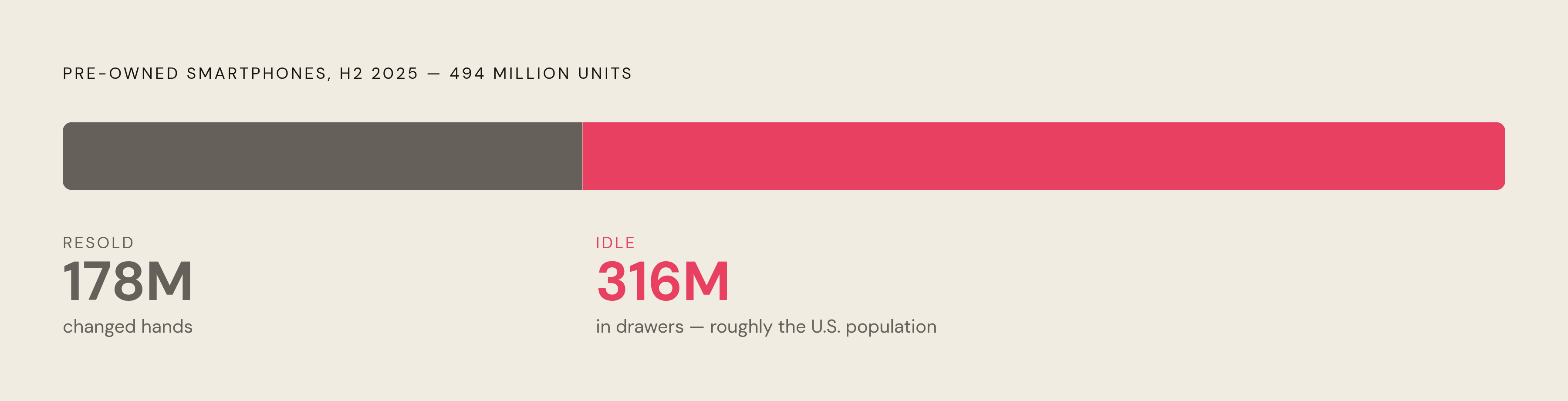
The numbers on this get big fast. In the second half of 2025 alone, 494 million pre-owned smartphones were floating around the world, just sitting there, technically usable. Of those, only 178 million actually got resold https://doi.org/10.3390/resources11020018. Do the math and that leaves 316 million phones that went into drawers or turned into "backup" devices nobody backs anything up to https://doi.org/10.3390/resources11020018.
That gap, 316 million phones, is the entire missed resale market for smartphones, and that's just one half of one year. It's not a rounding error. It's a market roughly the size of the U.S. population sitting in junk drawers, doing absolutely nothing for anyone.
Zooming out, the picture gets heavier, literally. Only 22.3% of that got properly collected and recycled https://usfblogs.usfca.edu/sustainability/2025/03/28/life-cycle-of-e-waste/. That total compares to 2010, when it was 34 billion kilograms, and the trend line points up https://usfblogs.usfca.edu/sustainability/2025/03/28/life-cycle-of-e-waste/. By 2030, e-waste is projected to hit 82 million metric tons, climbing at a pace of roughly 2.6 million tonnes a year https://usfblogs.usfca.edu/sustainability/2025/03/28/life-cycle-of-e-waste/ https://dtpgroup.co.uk/insight/50-e-waste-statistics-2025/. There's real money buried in that pile, too: the raw materials inside 2022's e-waste were worth an estimated $91 billion, and only $19 billion of that got recovered through proper recycling https://usfblogs.usfca.edu/sustainability/2025/03/28/life-cycle-of-e-waste/. Small equipment, think blenders, routers, old game consoles, made up the biggest chunk of that waste by weight https://usfblogs.usfca.edu/sustainability/2025/03/28/life-cycle-of-e-waste/.
Smartphones: the shortest useful life and the fastest-closing resale window
Phones move fastest through the whole cycle, and they're the clearest example of a resale window opening and slamming shut. The average consumer replacement cycle dropped to 2.49 years in 2025, the shortest span recorded since anyone started tracking this back in 2014 https://www.statista.com/statistics/619788/average-smartphone-life/. People aren't waiting for phones to die.
So there's a stretch, sometimes a long one, where the phone works fine but nobody wants it anymore. That stretch is the resale window, and it's shrinking in relative terms even as the phone itself keeps ticking.
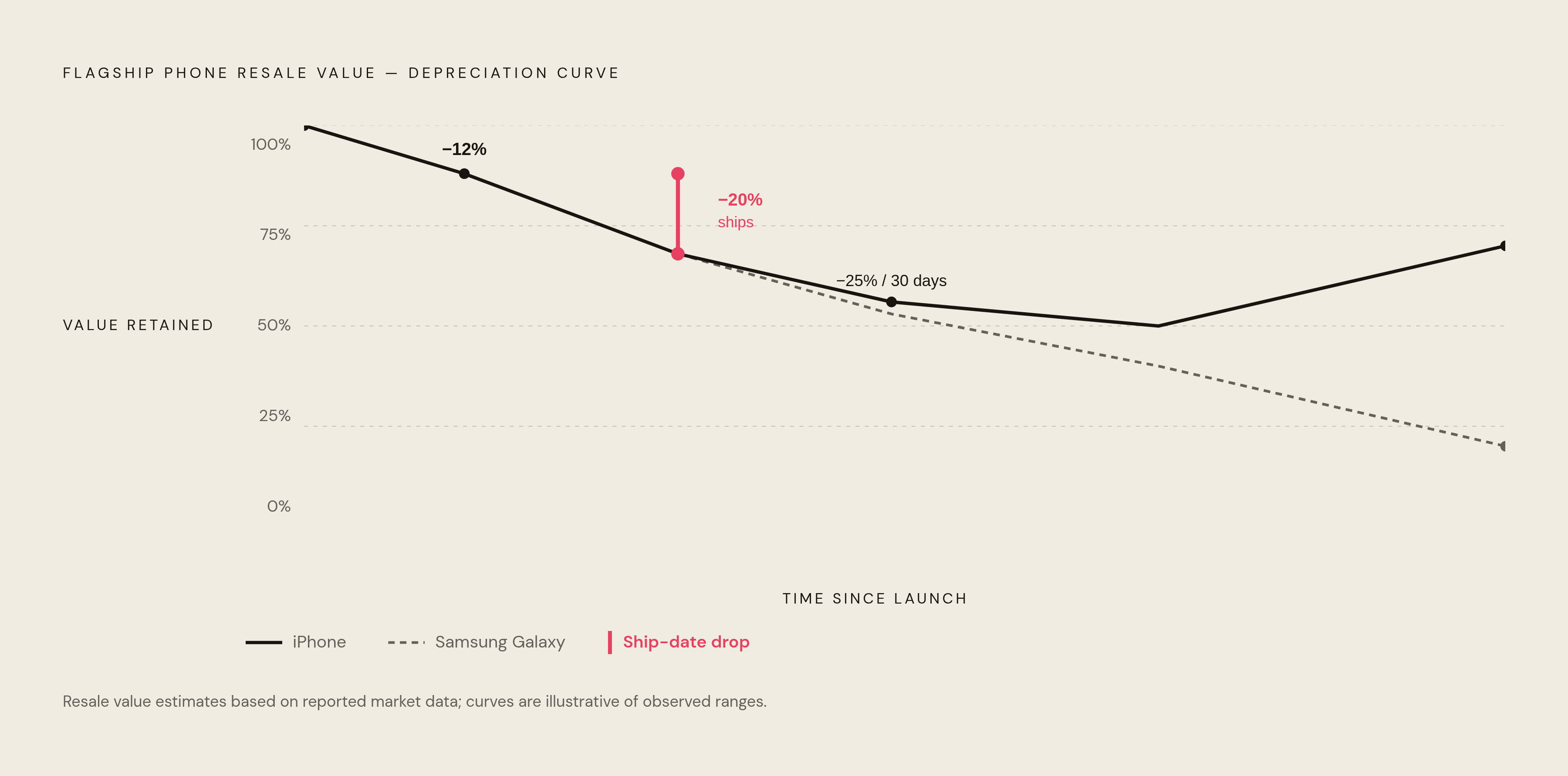
Value doesn't wait around while owners make up their minds. A new flagship phone can shed 20 to 30% of its value in the first year alone, and by year three, plenty of models are worth less than 40% of what they cost new https://www.reclaimstuff.com/used-electronics-resale-value. Brand affects how quickly a device loses value. Recent iPhones in good shape typically lose a quarter to a third of their value in year one, while comparable Samsung Galaxy flagships can lose 60% or more over that same stretch https://www.reclaimstuff.com/used-electronics-resale-value https://swappa.com/blog/used-electronics-resale-data/. Android phones on average depreciate about twice as fast as iPhones, with first-year losses ranging anywhere from 30% to a brutal 80% depending on the model https://swappa.com/blog/used-electronics-resale-data/. Prices on the outgoing model drop 9 to 15% within a day or two of a new flagship announcement, then slide another 20% once the new phone actually ships. iPhones alone can lose 15 to 25% of resale value in the 30 days after a launch https://swappa.com/blog/used-electronics-resale-data/ https://www.underpriced.app/tools/electronics-depreciation-calculator. Waiting to sell "until it feels like the right time" is, in practical terms, a decision to take a haircut. Physical lifespan is in fact longer than that, since iPhones can last 4–10 years and Samsung units 3–6 years, but it is precisely the gap between replacement and disposal where resale lives.
Laptops and tablets: longer physical lives, but faster value erosion than owners expect
Laptops typically have a useful device lifespan of roughly 5 years, though quality and care can stretch this to 8 years or compress it to 3. The battery inside usually gives out somewhere between 4.5 and 5.5 years.
Tablets tell a stranger story. Statista projects the average consumer tablet lifespan in the U.S. at 7.01 years in 2024, yet people replace them much earlier, typically after 3 to 5 years https://www.statista.com/topics/9540/recycling-and-reusage-of-consumer-tech/. That's a gap of two to four years where a perfectly functional tablet just sits there, doing nothing, worth less every month. It's the electronics equivalent of leaving a gift card in a coat pocket until it expires.
Laptops and tablets, alongside smartphones, show up specifically in the Exeter Centre for Circular Economy's research on lifespan extension, which is a fairly clear signal that these three categories are where current habits waste the most value. Part of the problem is psychological: a laptop that still boots up and opens a browser feels fine, even when a new chip generation has quietly made it feel like a fossil to anyone shopping for a replacement. "Still works" and "still worth something" are not the same sentence, no matter how much owners want them to be.
TVs, desktops, and printers: longer lives, but harder to sell once the moment passes
Smart TVs are the marathon runners of the electronics world, typically lasting 7 to 10 years. QLED sets tend to outlast OLED in real-world use, mostly because their backlight design sidesteps the burn-in problems that eventually creep into OLED panels. But the screen isn't usually what kills the deal. Manufacturers stop pushing software updates to the streaming apps long before the panel itself gives out, and that's the moment a buyer's interest quietly evaporates. A TV that can't run a current version of a streaming app is a TV nobody wants, regardless of how crisp the picture still looks. That's the real end-of-use moment for this category, and it usually arrives well before the "end-of-life" one.
Desktop PCs run 5 to 8 years before they physically give out, but the window where they're actually worth using hard, running demanding software, gaming, editing video, is more like 3 to 5 years.
Printers are the shortest-lived of this group and arguably the least loved. After that window shuts, resale value is close to nothing, and tossing the thing in the trash isn't harmless either, since the ink cartridges inside carry toxins that don't belong in a landfill.
Reasons devices end up in drawers instead of sold, and the cost to the owner
Phones, specifically, have a well-documented tendency to get "hibernated." That's the term researchers use for a device that gets used once, then shoved in a drawer indefinitely, never sold, never recycled, just... paused. It's less a decision than a non-decision, which is exactly the problem.
Three forces keep pushing people toward the drawer instead of the marketplace. Short usage time tricks the brain into thinking the device is newer, and therefore more valuable, than it actually is. Owners also tend to overestimate what their old gear is still worth, so they hold out for a number that stopped being realistic months ago. Nobody wants to be the person who accidentally mails their tax documents to a stranger in another state, so the device sits, unwiped and unsold, out of caution.
There's an emotional layer too. A phone holds photos, texts, years of context in a way a broken toaster never will, so parting with it feels weightier than it probably should.
None of this waiting is free. Every month a device sits untouched, it loses value, and the loss is front-loaded, so the early months of hesitation cost more than the later ones https://www.reclaimstuff.com/used-electronics-resale-value. Waiting a year to sell is a slow leak. It's a slow leak.
Pricing a used device accurately (what sold data shows versus what owners guess)
Platform-generated estimates aren't much better; both routinely undershoot what devices actually sell for on active marketplaces.
The only method that holds up is checking what identical items actually sold for recently, not what sellers are asking, but what buyers actually paid. eBay's completed listings filter and Swappa's transaction history are the clearest windows into real market clearing prices for used electronics, and neither requires guesswork.
Condition does the heavy lifting in that final number. A cracked screen or a dented corner can cost $150 to $400 at trade-in compared to an identical clean device https://www.reclaimstuff.com/used-electronics-resale-value. Describing condition honestly matters just as much as picking the right number in the first place. A complete kit, original box, charger, cables, the works, tends to sell for 10 to 25% more than the same item sold bare, a gap worth capturing in any listing https://www.pricesnap.ai/electronics-value-checker. That's not a small detail to skip in a listing.
Buyer appetite for used gear, for what it's worth, is climbing. Consumer interest in buying a certified pre-owned device was 17% in 2024 and rose to 25% in 2026 according to Assurant, and refurbished smartphone sales grew 6% year over year in the second half of 2025, with around 11% projected growth for 2026 https://www.gadgetsalvation.com/blog/how-ai-is-reshaping-used-electronics-resale. The market for "used but fine" is only getting bigger.
Matching the marketplace to the device category
No single platform wins across every category. The right pick depends on the device, its value, how heavy it is to ship, and how fast the seller wants cash in hand.
eBay carries the widest reach, with roughly 134 million active buyers worldwide, more than any other electronics resale venue. Rates shift, so it's worth a quick check at eBay's help center before listing anything. eBay makes the most sense for rare or collectible gear, vintage audio equipment, older game consoles, specialty items, where a global audience is worth the cut it takes.
It's a narrower platform, built specifically around phones, tablets, laptops, cameras, smartwatches, and video games, and it only accepts working devices with intact glass. For functional, mid-to-high-value electronics in solid condition, that focus tends to attract buyers who already know what they want.
Facebook Marketplace covers different ground entirely. Close to a billion people check it every month, and local pickup carries zero seller fees, so every dollar of a local sale stays with the seller https://www.gadgetsalvation.com/blog/how-ai-is-reshaping-used-electronics-resale. Shipped items carry a 10% fee on the total, with a minimum of $0.80 https://www.gadgetsalvation.com/blog/how-ai-is-reshaping-used-electronics-resale. It's the natural home for TVs, gaming consoles, and anything too bulky or cheap to justify shipping, and it's usually the fastest route to same-day cash for common items. Final value fees run approximately 12.9–15% of the total sale amount, plus payment processing, so a $300 sale carries roughly $45–$54 in platform fees, a figure sellers should confirm at eBay's help center before listing. The platform charges buyers a fee, typically $5–$25 depending on price, not sellers, who pay $0 in selling fees, though PayPal or Stripe processing and shipping still apply.
Acting before the window closes (what the lifespan data tells a seller to do)
The pattern across every category points the same direction: the device that "still works fine" is exactly the device losing value the fastest, quietly, in a drawer, while its owner waits for a moment that isn't coming. Phones lose the most, the fastest, especially in the weeks around a new launch. Laptops and tablets erode more slowly but just as surely, hollowed out by each new chip generation. TVs and desktops hang on physically but lose their real value the day software support walks away.
None of that is a reason for panic. It's a reason for timing. A month of a device sitting untouched closes the resale window between end-of-use and end-of-life a little more. Selling early, honestly, and on the right platform for the category is the choice the data actually backs. It's the one the data actually backs. Electronics are typically only used for 1.5 to 13 years, with most averaging 4.5 years https://www.webformix.com/tech-device-lifespan/. In 2022, a record 62 billion kg of e-waste was generated globally https://usfblogs.usfca.edu/sustainability/2025/03/28/life-cycle-of-e-waste/. In 2022, e-waste generation was equivalent to an average of 7.8 kg per capita per year https://usfblogs.usfca.edu/sustainability/2025/03/28/life-cycle-of-e-waste/. Electronic waste is an unprecedented problem expected to rise 33% by 2030 https://usfblogs.usfca.edu/sustainability/2025/03/28/life-cycle-of-e-waste/.
Sources
- Device Lifespan: How Long Will Your Tech Last? - Webformix Internet
- Topic: Recycling and reusage of consumer tech
- End-of-Use vs. End-of-Life: When Do Consumer Electronics Become Waste? | MDPI
- Life Cycle of E-Waste
- U.S. smartphone replacement cycle by segment 2029| Statista
- CE-Hub Digital Series: Extending the Life of Consumer Electronics - Exeter Centre for Circular Economy
- dtpgroup.co.uk
- gadgetsalvation.com