Items That Lose the Most Value When Kept Too Long
Sell your phone before the next model drops, not after.
Every category of used stuff, phones, cars, furniture, the works, follows a depreciation curve that front-loads the pain. Most of the value disappears fast and early, then the slope flattens out. The math says sell before the cliff, not after, and most people wait until well after.
How depreciation curves work, and why they are front-loaded for almost every category.
A depreciation curve just describes how fast something loses resale value over time. The shape is almost never a straight line. Electronics, cars, furniture, clothes: nearly everything loses value fastest right at the start, then levels off. Think of a hot cup of coffee cooling on a counter. The temperature drop is steep in the first few minutes, then it sits there lukewarm for hours. That's the curve, and it means value drops steeply at first before leveling off, just like the coffee cooling on the counter.
Two forces cause the early cliff. Supply surges first: when a new phone or laptop drops, everyone upgrading dumps their old unit on the resale market at roughly the same time, and suddenly ten thousand identical listings are chasing the same buyers. Then comes the obsolescence signal. A new release resets what "current" means, and last year's flagship, which worked perfectly fine yesterday, is suddenly the old one nobody wants.
Some categories drift down slowly. Others fall off a cliff overnight, the moment a company announces a new model or kills software support for an old one. That distinction is the one that actually decides what you get paid. Every item has a sell window, the stretch between buying it and the point where every extra week you hold it costs more than it's worth. Some windows last weeks. Others last years. Guessing which is which is how people leave money on the table.
Smartphones: the category where waiting weeks, not years, costs real money
Start with the platform split, because it settles most of the argument by itself. According to Swappa's resale data, the average iPhone holds onto roughly 60 to 70% of its value after one year. The average Android phone holds 40 to 50%. Android depreciates roughly twice as fast, and no camera upgrade or fancy hinge changes that math.
Samsung's flagship line has closed the gap some, gaining about 5 points of retention between 2022 and 2025, with the titanium-bodied S Ultra models holding value best among Android phones. Still, SellCell's 2026 data tells a rough story. The iPhone 16 (128GB) is down 50.2% since launch. The Galaxy S25 (128GB) is down 62.0%. The Galaxy S24 (128GB) is down 74.5%. The Galaxy S23 (128GB) is down a brutal 82.4%. If you're holding an Android flagship from two generations back, the resale conversation is basically over before it starts.
The launch-event cliff is the pattern that actually matters for timing a sale. iPhones typically shed 15 to 25% of resale value within 30 days of a new model launch, with the steepest single drop landing the week Apple announces the next generation. The smart window to sell sits four to six weeks before a September launch, while demand is still strong and buyers haven't reset their idea of what counts as current.
Condition details move the number more than most sellers expect. A factory-unlocked phone can sell for $50 to $100 more than the identical carrier-locked model, and buyers check battery health percentage the way they'd check a used car's odometer. If a phone in the drawer is already one generation behind, it is losing value. It's how much more you're willing to watch drain away before you list it.
Laptops and tablets: slower curves but a hard floor that arrives around year three
Laptops depreciate slower than phones, but the floor still appears on schedule. MacBooks lose roughly 15 to 20% of value per year, and Apple Silicon models hold up best: Growrk's data has them retaining 40 to 60% of original value at the three-year mark. Premium Windows ultrabooks land lower, retaining 20 to 30% by year three on Growrk's numbers (Swappa puts that same figure closer to 25 to 40%, so call it a wide but consistent gap either way).
Windows laptops overall fall harder and faster, sometimes losing 50 to 70% in year one alone, though premium Dell, HP, and Lenovo ultrabooks manage to hold 25 to 40% at three years. Across computing gear generally, the pattern holds: 40 to 60% retention in the first two years, then a drop below 20% by year four. Sell before year four. That isn't a friendly suggestion, that's just the math working against anyone who waits.
Battery health quietly speeds up the whole curve. A MacBook at 85% battery health can sell for 10 to 15% less than an identical model at 95%, and that gap widens as the battery keeps fading. Tablets split by ecosystem the same way phones do: iPads age gracefully thanks to long software support windows, while Android tablets lose a big chunk of value the moment update support runs out. The hardware still works fine. Nobody wants it, because the software already walked away from it first. Laptop owners get more runway than phone owners, sure, but riding a Windows laptop past year three, or an aging Android tablet past its update cutoff, means fishing in a pond that's draining by the day.
Gaming consoles and audio gear: two categories where the usual rules don't apply
Consoles break the front-loaded pattern entirely, at least for a while. When supply is tight and a console's exclusive titles are in demand, resale value holds steady or even climbs. Swappa's data shows a PS5 retained roughly 70 to 80% of retail price across its first couple of years, which is almost unheard of for consumer electronics.
The curve inverts, then normalizes: value stays elevated while supply is constrained, then depreciates once scarcity fades and the market rebalances. The sell window for a console isn't the launch date, it's while the scarcity premium still holds, before it evaporates. Missing the original controller cuts what a console sells for in a way that missing a phone charger never would. Missing the original controller cuts a console's resale value meaningfully, because completeness drives price in this category.
Audio gear runs on an entirely different rulebook, where category decides value retention, not age. Headphonesty's analysis of resale data from Audiogon, eBay, and Head-Fi found that tube amplifiers and flagship headphones hold value unusually well, with tube amps often retaining 80 to 90% of value after a full year, propped up by serviceable components, a dedicated tube-rolling hobbyist culture, and low production runs. Compare that to USB interfaces, DSP-heavy systems, and "smart" audio gear, which can work perfectly and still sell for pennies, because their value rides on ongoing firmware support. Once that support ends, resale value drops even though the hardware hasn't changed one bit.
A five-year-old tube amp can outsell a two-year-old smart speaker without much of a fight. Age isn't the variable doing the work here. Category is, full stop.
Vehicles: where front-loaded depreciation is measured in tens of thousands of dollars
Cars make the front-loading pattern painfully literal, because the numbers aren't percentages of a cheap gadget, they're chunks of a much bigger purchase. FinanceWonk's update shows a new car loses about 20% of its value in year one alone, and roughly 60% by year five, with the steepest drop concentrated in years one and two before the rate of loss gradually slows.
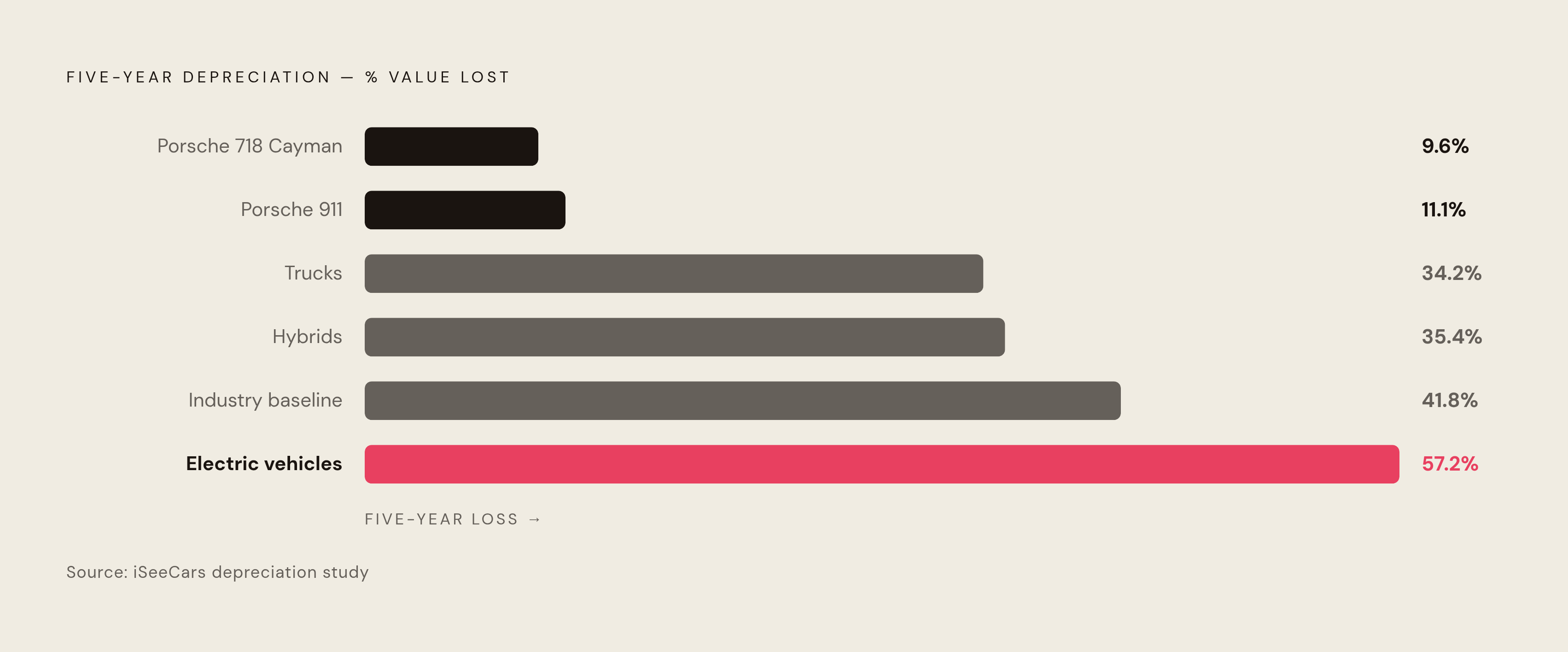
iSeeCars' study, built on more than 950,000 five-year-old used cars sold between March 2025 and February 2026, sets the industry-wide baseline at 41.8% average five-year depreciation. Some models blow well past that. The Nissan LEAF loses 63.1% over five years. The Infiniti QX80 loses 62.8%. The Volkswagen ID.4 loses 62.1%. The Tesla Model S and Model X lose 62.0% and 61.2% respectively. The Land Rover Range Rover loses 61.7%, a figure that sounds close to the others until the dollar amount lands: an average loss of $69,856 from MSRP, the largest dollar loss of any model in the ranking.
Notice how many of those are EVs. That's not a coincidence. As a segment, EVs lose 57.2% of value after five years per iSeeCars, against 34.2% for trucks and 35.4% for hybrids. The gap comes down to battery technology improving fast, incentive programs shifting under buyers' feet, and plain old range anxiety. U.S. News crunched the numbers on a 2022 Tesla Model S and found it had lost 61.53% of value, dropping from an average new price of $120,490 to an average used price of $46,359. That's a $74,132 hit, roughly what a lot of people put down on a house.
Sports cars break the rule entirely, and the reason matters more than the exception itself. The same iSeeCars data shows Porsche's 718 Cayman depreciates just 9.6% over five years, the 911 loses only 11.1%, and the Chevrolet Corvette loses 18.7%. Enthusiast demand and small production runs do for sports cars what tube-rolling culture does for audio gear: they turn depreciation into an afterthought. FinanceWonk reporting flags a temporary 2026 wrinkle too. Tariffs on imported vehicles and parts are pushing new car prices up, which slows used-car depreciation on some models as buyers shift toward used inventory. It's a nudge, not a new rulebook: tariffs on imported vehicles and parts are pushing new car prices up, which slows used-car depreciation on some models as buyers shift toward used inventory. A fast-depreciating EV or a full-size luxury SUV sitting in the driveway is costing more every year than almost anything else owned.
Clothing and furniture: slower curves, but condition and timing still define what you recover
Clothing mostly loses value fast once it's been worn, with one loud exception. Brands that guard their exclusivity hard, Hermès and Chanel being the obvious names, hold resale value unusually well, and certain Birkin bags have, over some stretches, appreciated faster than gold. It's the exception, not the rule: certain Birkin bags have, over some stretches, appreciated rather than depreciated, but that outcome is rare. Don't build a resale strategy around finding the next one buried in a closet somewhere.
For everyday clothing, the numbers (aligned with a tax authority's guidance for 2025 to 2026) run roughly like this: excellent-condition pieces often clear 30 to 40% of original retail, good-condition pieces land closer to 10 to 20%. Brand recognition shifts things up or down within that range. Levi's, Patagonia, and Nike sit consistently near the top of their bracket, while J.Crew moves a lot of volume on resale but tends to recover less per item than top-tier brands.
The timing risk here looks nothing like the smartphone cliff. There's no launch event to dodge, no announcement that tanks the price overnight. It's slower and quieter: condition drift and trend decay. A jacket in excellent shape today can slide into merely good shape next year, dropping it from that 30 to 40% bracket straight into the 10 to 20% one. A national statistics agency folded secondhand apparel into its consumer price gauge in early 2025, a fairly clear sign this market grew past hobbyist territory into something with real economic weight.
Furniture tells a blunter story. Mass-produced pieces lose a huge chunk of resale value almost the moment they leave the showroom, thanks to shifting style trends and, frankly, how flimsy a lot of flat-pack furniture actually is. Retail markups on furniture can be substantial, which creates the illusion that a couch is worth what you paid for it. It isn't, not once it's out the door and sitting in the living room. High-end designer furniture and genuine antiques hold value, but odds are that's not what's under the coffee mug right now. For clothing and furniture both, the sell window tracks condition rather than a calendar date, and condition only moves one direction: down. Every month spent waiting is a month the item gets a little worse and the check gets a little smaller.
The items most likely sitting in your home right now, and where each sits on its curve.
Some of what's around the house needs to be listed today. Some has a year or two of room to breathe. None of it gets more valuable by sitting still, no matter how long it waits on the shelf hoping otherwise.
Highest urgency, meaning list it now or watch the number keep shrinking:
- Smartphones one generation behind, especially Android flagships. Cumulative losses since launch already run 60 to 74% on recent Galaxy models.
- EVs headed for a sale within five years. With average five-year losses at 57.2%, every extra year of ownership just extends the bleed.
- Smart audio devices whose manufacturer scaled back software support. The hardware might work fine. The resale value doesn't care, because the hardware was never the real basis of the price.
- Windows laptops in years two and three, still in that 25 to 40% retention band but heading toward the year-four cliff where value drops below 20%.
Moderate urgency, where there's still runway but it's shortening fast:
- Android tablets nearing the end of their update cycle. Once support ends, the resale floor drops even though nothing about the device changed.
- Furniture and clothing sitting in good, not excellent, condition. The gap between those two brackets can be significant, and it only widens with time.
None of this is a case for panic-selling everything in the garage by Friday. It's a case for knowing exactly where each item sits on its curve instead of guessing. The market is bigger than it has ever been, more buyers, more sellers, more categories moving through resale channels than at any point on record. Size doesn't slow the clock down, though. If anything, it speeds things up, because every new seller listing an item competes against the exact one sitting in the closet, and that item is already at a specific spot on its own curve. The only real decision left is timing.
Sources
- Tech Depreciation: How Fast Electronics Lose Value
- Cars With the Fastest Depreciation in 2026 | U.S. News
- FinanceWonk — Free Financial Calculators & Tools
- New Study Reveals Fastest and Slowest Depreciating 5-Year-Old Vehicles in 2026
- Resale Data Exposes Which HiFi Gear Acts Like An Investment And Which Crashes Right After Unboxing | Headphonesty
- sellcell.com
- growrk.com
- bls.gov