The Endowment Effect and Why People Overprice Their Own Stuff
Ownership tricks your brain into thinking your stuff is worth far more than buyers will pay.
In 1990, a bunch of Cornell students got handed coffee mugs, and economics has never quite recovered. The endowment effect means people slap a higher price tag on things simply because those things are already theirs, and it's why your old blender feels like a treasure and looks, to everyone else, like a blender. Understanding the mechanism is step one to pricing like a seller who actually wants to sell, not one who wants a hug.
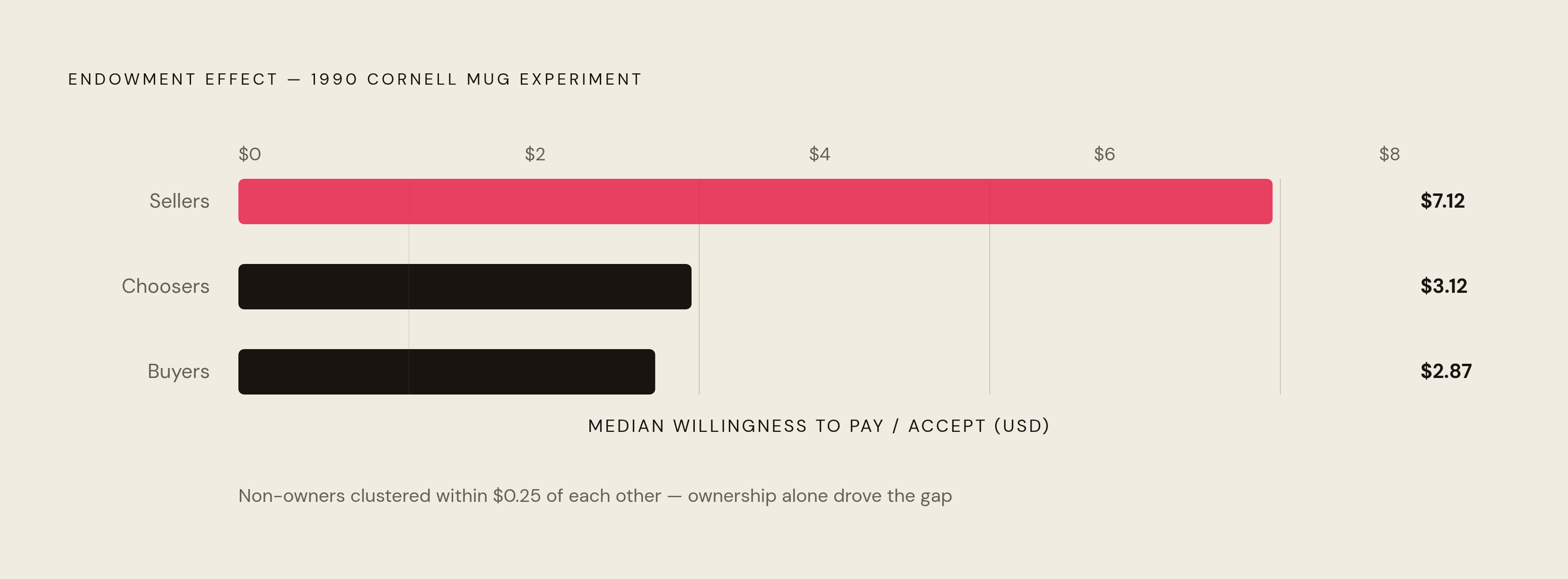
The mug study, run by Kahneman, Thaler, and Knetsch and published in the Journal of Political Economy that same year, is still the cleanest proof out there. Half the students in a Cornell class got a mug from the bookstore, worth a few bucks. The other half got nothing. A third group, the "Choosers," got to pick between a mug or its cash equivalent. Sellers wanted a median of $7.12 to part with the mug. Buyers offered a median of $2.87 for the identical mug. Choosers, who never owned it and were just picking a preference, landed at $3.12, almost exactly where the buyers were. The mug is the same one. Same room. Same afternoon. A substantial gap in perceived value, created entirely by a brief period of ownership.
The finding was that owning something changes what your brain thinks it's worth. It's that owning something changes what your brain thinks it's worth. And if you've ever listed something secondhand, congratulations: you're the seller in this experiment, mug in hand, asking $7.12 for something the market values at three bucks.
It's not just a mental quirk, either. Research into the neuroscience of ownership has found that the brain registers owned items differently than identical unowned ones. Ownership is a feeling you register, the same way you'd register a good smell or a warm room. It's a feeling you register, the same way you'd register a good smell or a warm room.
The three psychological mechanisms that drive the bias
Three things are working against you the moment you try to price your own stuff, and none of them are your fault, exactly.
Loss aversion is the main engine. Kahneman and Tversky's research shows people weigh losses roughly twice as heavily as equivalent gains. So when you sell something, your brain doesn't file it as "getting money." It files it as "losing an object," and losing things feels bad in a way that's disproportionate to the object's actual usefulness. The endowment effect is just loss aversion wearing a price tag.
Cognitive dissonance piles on next. After a big or difficult purchase, there's mental friction between "I spent a lot of money" and "was that smart?" To resolve the tension, people quietly inflate the value of what they bought. It's a retroactive justification, and it scales with the original price. The more you paid, the harder it is to hear a lowball offer without taking it personally.
Psychological ownership is the sneakiest of the three, because it doesn't even require legal ownership to kick in. Research from Pierce, Kostova, and Dirks shows a sense of "mine" can form just from proximity or use. A 2020 study in Consciousness and Cognition found the endowment bias correlates with ownership effects in memory, but only in participants from cultures with a more independent sense of self, not those from cultures with a more interdependent one. Self-referential thinking, in other words, is baked into the bias, not just an emotional side effect, and how strongly it appears depends on cultural ideas about self and possession.
Here's the real crux, though: buyers and sellers aren't just disagreeing on a number, they're operating in two completely different frames. The seller is focused on what they're giving up: the memory, the anticipated loss, the felt sense of "this was mine." The buyer is focused on what they're spending: the tradeoff, the opportunity cost, what else that money could buy. These frames are not equally loud. Loss is vivid and immediate. A purchase decision is comparative and cold. Companies exploit this gap on purpose, which is why free trials and money-back guarantees exist. Once you feel like you own something, you're far less likely to give it back, even with zero financial risk.
How the bias shows up when sellers price their own stuff
Take the laptop. Somebody buys one for $1,000. A year later, it's still in great shape, barely a scratch, so they list it for $900, reasoning that it's a "deal" compared to the price of the newest model. Then the offers come in: $600, $400, a comment calling it overpriced, a link to a cheaper alternative someone found in four seconds.
The seller's internal monologue is "this is basically new." The buyer's internal monologue is "this is a used laptop competing with fifteen other used laptops." Neither of them is wrong. They're just pricing from different planets.
Sellers tend to anchor on three things buyers never see:
- The amount they originally paid, an internal number with zero relevance to a stranger.
- What the item means to them, the memories or effort or identity wrapped up in it.
- What it would cost to replace new today, which is a real data point, but only a starting line for depreciation, not the finish.
The collectibles world shows this in its most extreme form. Owners sometimes decide their item matters more than any market number, which leads them to turn down offers that are genuinely above market, because their personal valuation is even higher. Owners turning down above-market offers because their personal valuation is even higher isn't negotiation; it's just holding forever. That's just holding forever.
Real estate runs the same script. Homeowners routinely price a house based on personal attachment rather than what the market will bear, and that emotional premium is a documented reason homes sit unsold or take longer to close. The item doesn't move, the buyer moves on, and the seller reads the silence as "nobody appreciates quality" instead of "the price is wrong."
Why the buyer sees something completely different
Buyers are just looking at a different picture entirely: a used object, sitting in a sea of nearly identical used objects, all one scroll away from each other. They're just looking at a different picture entirely: a used object, sitting in a sea of nearly identical used objects, all one scroll away from each other.
Their questions are different too. Not "what did this cost originally," but "what's the cheapest equivalent available right now." Not "how well was this cared for," but "what condition does this look like it's in, and what am I risking." Not "what does the seller think this is worth," but "what did the last one of these actually go for."
That last question is the whole game. Active listings tell you what sellers are hoping for. Sold listings tell you what buyers actually handed over cash for. The gap between those two numbers is, in a real sense, the endowment effect made visible as data you can point to.
And buyers today have options. According to OfferUp's Recommerce Report, 93% of Americans bought something secondhand in 2025. That's not a niche of bargain hunters, that's most of the country, comparing prices with the casual fluency of people who've done this before. Emotional pricing gets punished fast in a market that crowded.
The personal history of your item, where you bought it, what it meant, how gently you used it, is completely invisible to a stranger three time zones away, scrolling on their lunch break. The invisibility of an item's personal history to a stranger three time zones away, scrolling on their lunch break, is just how open markets work. It's just how open markets work.
How to check what an item is worth using sold data
Sold listings show what buyers paid. Active listings show what sellers wish someone would pay. Always price off the former.
eBay's sold filter is the most reliable free tool for this. Search the exact item, matching make, model, size, and colorway where it matters (a search for "Nike Dunk Low Panda size 10" gets you real comps; a search for just "sneakers" gets you noise). Filter to Sold listings only. Look at the range, then find the median, that's your fair market value baseline. Anything wildly high that never actually sold is an active listing pretending to be a comparable. Ignore it.
Facebook Marketplace doesn't show sold prices the way eBay does, so pricing there without checking sold data somewhere else is closer to a guess than a strategy.
Condition adjustments are the step almost everyone skips. Avoid comping a worn item against a mint one. Don't comp an incomplete set against a full one. Don't comp untested electronics against tested ones, buyers price in that risk automatically, whether the seller accounts for it or not. Original accessories, chargers, manuals, the box, can meaningfully bump the price, so list what's included rather than assuming it's implied.
Current retail price is a useful depreciation anchor, but it has to be today's price, from Amazon, the manufacturer, or a major retailer, not what you paid three years ago before the price moved. If the model's discontinued, find the closest current equivalent and start there.
And if the item hasn't sold in a week, the market has already answered the question. Dropping the price meaningfully below fair market value lets it move instead of staring at a listing that's aging like unrefrigerated fish.
The endowment effect across common resale categories
Electronics depreciate faster than almost anything else, which makes the original-price anchor especially painful to let go of. Retro consoles buck the trend though: NES, Game Boy, and early PlayStation units can command strong prices thanks to nostalgia demand. Weirder still, some of the most underpriced items in this category are things sellers assume are worthless: old TV remotes, routers, calculators, and 2000s point-and-shoot cameras like the Canon PowerShot or Nikon Coolpix, which are riding a "low-fi" aesthetic wave right now.
Clothing and fashion is a high-volume, high-competition category. Upright Labs' 2025 data shows clothing, shoes, and accessories generated nearly $60 million in revenue across 2.5 million items sold, which tells you two things: there's real demand, and there's also zero room for emotional pricing, because a buyer can find the next comparable listing in seconds. Limited-edition sneakers are one of the rare exceptions where a seller's gut-feeling price and the actual market price line up, because scarcity is doing real work there. Everyday clothes don't get that luxury. Sellers price based on how much they loved the jacket, buyers price based on brand, condition, and what the last one sold for.
Jewelry and watches are currently a category where the bias can cut the opposite direction. Gold hit historic highs in 2025, and sellers anchoring to what they paid years ago, rather than checking current melt value, are leaving money on the table. Seiko watches have seen meaningful increases in average sale price recently, a reminder that "sold data" has an expiration date. Old comps go stale fast in a moving market.
Home goods and appliances are where the "I paid a lot for this" trap is most visible. Bread makers, juicers, air fryers replaced by a newer model, these are some of the most overpriced items in resale, because sellers anchor to retail cost in a category buyers see as crowded and disposable. KitchenAid stand mixers are the exception that proves the rule: certain colors and models hold a notably strong share of their original price, and brands with loyal followings (KitchenAid, Dyson) genuinely hold value better. Brand loyalty is a legitimate pricing factor, it just still needs sold-data proof, not vibes.
Collectibles are where the endowment effect does the most damage. Pokémon and Magic: The Gathering cards remain strong sellers, and professional grading through PSA can multiply value, but only when the market actually agrees with that grade. Owners who decide their card or figure or comic matters more than any offer on the table risk turning down real money and holding an item indefinitely. Sold data and professional grading are the only honest anchors here. Everything else is a story you're telling yourself.
Choosing the right marketplace once you have an honest price
Getting the price right doesn't mean much if a platform's fees quietly eat the difference, so the "net" price matters as much as the sticker price.
Facebook Marketplace charges 0% for local sales in 2026, though shipped sales carry a 5% fee (minimum $0.40), and sellers have had to provide and pay for their own shipping labels since February 24, 2025, with prepaid labels quietly reintroduced for some sellers by September 2025. eBay runs about 14% combined on typical standard-category sales in 2026 (a 13.6% final value fee plus an order fee). Poshmark takes 20%. Etsy takes 6.5% plus a $0.20 listing fee. Depop charges 0% for sellers in the US.
Matching category to platform from there is mostly common sense. eBay makes sense for electronics, tools, and collectibles, thanks to global reach and transparent sold data. Facebook Marketplace fits furniture, bulky home goods, and large appliances, since local pickup sidesteps shipping costs and hassle. Poshmark and Depop are built for fashion, streetwear, and vintage clothing, where buyers already expect a curated, style-driven browsing experience.
None of this erases the mug sitting on your desk that you'd never sell for $2.87. Once the listing's price comes from sold data rather than sentiment, the item becomes what it actually is: an object, for sale, competing with a hundred others just like it.