Carbon Footprint of New vs Secondhand Goods
Buying used cuts manufacturing emissions, but the math is messier than advocates claim.
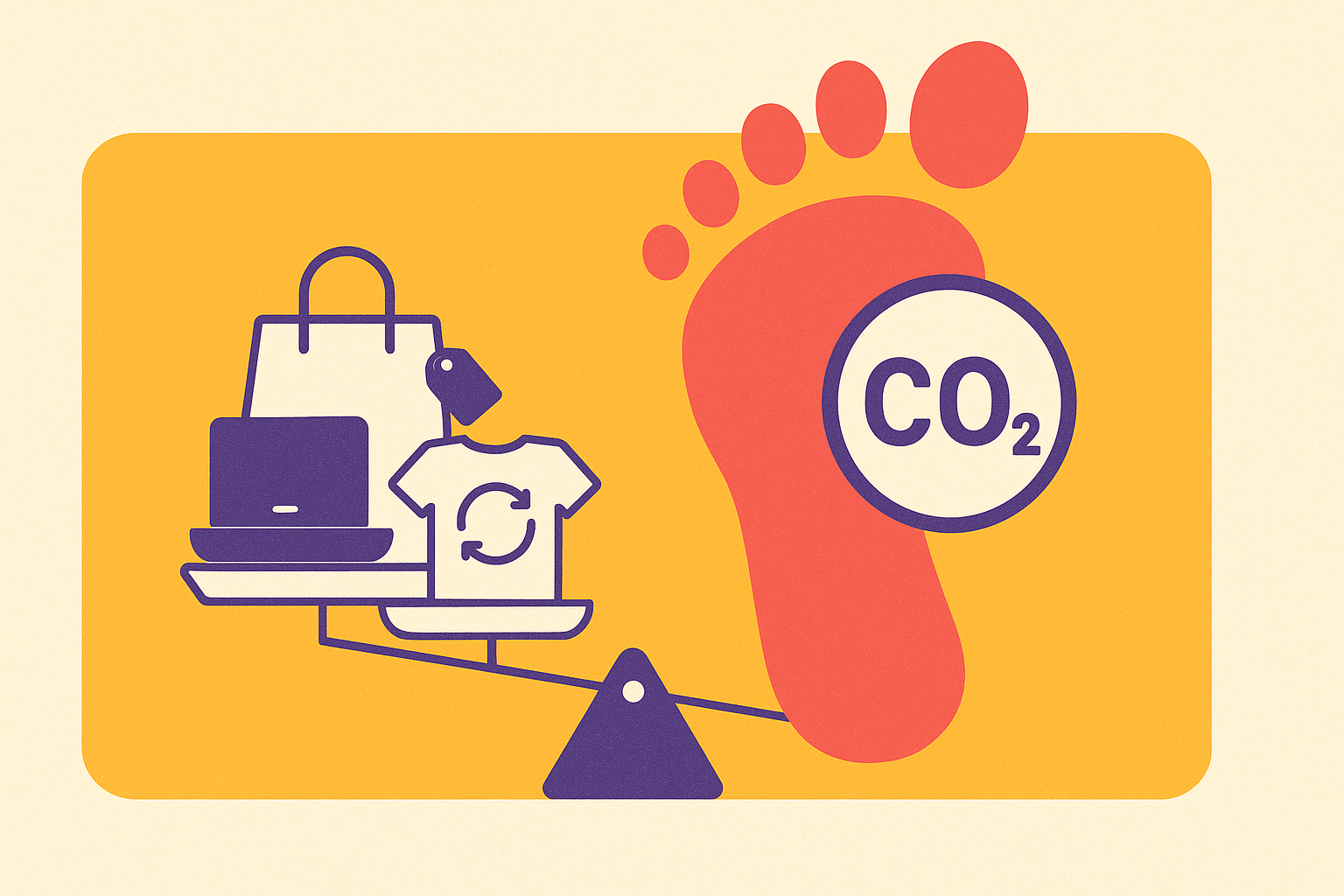
The gap between a new product and a used one isn't really about the item itself. The mining, the spinning, the molding, and the shipping all happened before the item existed. That's where almost all the carbon damage gets done, and that's why buying secondhand is one of the few climate actions a regular person can take that has a number attached to it, not just a feeling.
Why manufacturing emissions dominate a product's lifetime carbon footprint
Most people picture a product's environmental impact as something that happens gradually, adding up over its use, but that is not how it works. The heaviest emissions load gets dumped on the product before it ever reaches a store shelf, in one dense block, front-loaded like a bad exam schedule.
Raw material extraction, spinning yarn or forming components, dyeing, cutting, assembling, shipping across oceans. All of that happens before anyone even touches the thing. ThredUp's environmental assessment lays out the apparel version of this chain step by step: raw material extraction, yarn production, fabric production, dyeing, cutting and sewing, transportation, washing, disposal. A secondhand purchase skips almost the entire list. It just adds a resale step onto a garment whose manufacturing bill was already paid, a long time ago, by someone else's purchase.
That's the whole logic in one sentence: reusing an item doesn't create new manufacturing emissions, because those emissions are sunk cost, already spent, already in the atmosphere. Whether a new item gets made at all is the only lever left. Zoom out and the scale gets serious fast. The European Parliament reports that the textile industry alone accounts for around 10% of global greenhouse gas emissions. And this isn't just a clothing story: material production for machinery accounted for 8% of global greenhouse gas emissions in 2015 ThredUp / Retail Dive. Different industries, same pattern. Making the thing is the expensive step.
How large the manufacturing carbon gap is, category by category
Not all products are created equal, carbon-wise, and that matters more than most sustainability messaging lets on. Same category. Same store, probably. Wildly different manufacturing bill.
Footwear tells a similar story. That's a significant share, not a rounding error. That's an entire sector's worth of shoes.
Electronics push the intensity even higher. A 2025 study in Communications Earth & Environment on U.S. smartphone markets found that when reuse increases, manufacturing demand drops by 15% and carbon emissions by 14%, with just 25% consumer participation Ulan Software Trellis. Furniture rounds out the picture at a different scale entirely: the company's Circular Economy Impact Report shows that a secondhand sofa bought through Carousell saves up to 131 kg of CO₂e on average. The takeaway here is "know what you're buying."" It's "know what you're buying." A phone and a t-shirt are not the same decision, carbon-wise, even if they cost the same amount of money. Clothing: one pair of jeans generates 44 pounds of greenhouse gas emissions in production, that is 4–5 times the footprint of one t-shirt (same category, radically different manufacturing intensity) Future Card. Footwear: an MIT study found the typical pair of running shoes or sneakers produces nearly 30 lbs of carbon emissions, and sneaker production overall contributes nearly 1.5% of global greenhouse gas emissions as a single industry.
What "avoided production" means in practice, and the 1-for-1 displacement assumption
Every big secondhand carbon-savings number rests on one assumption: that each used item sold replaces the production of one new equivalent item. That's the standard used by Schibsted and the IVL Swedish Environmental Research Institute. Carousell, working with Vaayu, does something more careful: it applies a category-specific Displacement Rate, around 56% on average, pulled from actual buyer surveys instead of assuming perfect 1-for-1 swap. That distinction matters, because the 1-for-1 assumption is the load-bearing plank holding up basically every large-scale claim in this space.
Consider what that plank supports. Schibsted's Second Hand Effect report tracked eight countries (Finland, France, Hungary, Italy, Morocco, Norway, Spain, Sweden) and found 16.3 million tonnes of CO₂ saved, equal to the annual emissions of 1.8 million Europeans. Carousell's 2022 figures, using the same logic, put avoided emissions at 116,577 tonnes across Fashion & Luxury, Electronics, Furniture & Home Living, and Hobbies & Toys, equivalent to what 5.3 million trees absorb in a year Carousell Group Circular Economy Impact Report / SustMeme. Big numbers, built on a tidy assumption.
Reality is messier, and the smartphone data proves it. The same Communications Earth & Environment study found each secondhand transaction actually displaces 0.40 new devices, not 1.0, and extends the device's use time by 40% ThredUp / Retail Dive CLOSO. Longer use is good. But shortened use times elsewhere in the system offset nearly half the potential gains ThredUp / Retail Dive CLOSO. That 0.40 figure is the sharpest, most specific challenge to the 1-for-1 story in the entire body of research CLOSO. Partial displacement still saves carbon. It just saves less of it than the big round numbers imply.
The circular rebound effect: when the money saved gets spent on more stuff
Money saved on a used item doesn't vanish. It goes somewhere. A study published in ScienceDirect modeled what researchers call the "circular rebound effect," where savings from buying secondhand (or income earned from selling it) gets spent right back into the economy, often on other carbon-intensive goods, quietly eating into the emissions that were just avoided. The researchers ran this model against more than 239,000 listings across 32 categories on a major Swedish secondhand marketplace, so this isn't a thought experiment on a whiteboard ScienceDirect.
Behavioral data backs it up in an uncomfortable way. A nationally representative U.S. survey of 1,009 consumers found secondhand consumption is positively correlated with new clothing purchases, with a correlation of 0.58, especially among younger consumers and frequent shoppers NCBI / NIH study. Translation: some of the people buying the most secondhand are also buying the most new. The savings and the spending are happening in the same shopping cart, sometimes literally.
Separate research in the Journal of Circular Economy, from Klooster, Bellostas, Henry, and Shen, adds a wrinkle that's almost funny in how counterintuitive it is: a secondhand item that barely gets worn can end up with a higher environmental impact than a new item that gets used for years. Buying used doesn't automatically make someone a climate hero. It's not futile, though. Think of it less like a broken promise and more like a ceiling. Rebound spending caps how much good a secondhand purchase does. It doesn't erase the good entirely.
What determines whether a secondhand purchase cuts emissions: use, retention, and displacement
Three things separate a secondhand purchase that actually helps the planet from one that's just... a purchase. First, displacement: did this replace a new buy, or did it just add another item to the pile? Second, retention: how long does the buyer actually keep and use the thing before it gets discarded or resold again, because short retention quietly erodes whatever lifecycle gains existed in the first place. Third, re-spending: does the money saved stay out of carbon-heavy spending, or does it fund the next haul?
The Journal of Circular Economy notes that secondhand is "particularly beneficial for high-production impact clothing items" like jeans, heavy outerwear, and furniture, and less impactful for something low-cost to make in the first place, like a basic t-shirt. That 34% lower annual carbon footprint from circular smartphone consumption only holds if the secondhand device genuinely replaces a new one, and researchers treat that number as the upper end of realistic outcomes, not the guaranteed default Trellis.
Zoom out to the industry level and the same math appears in aggregate emissions data, just bigger. ThredUp estimates that if retailers made one fewer item for every used item someone bought, apparel production could shrink by nearly 8% by 2027, a meaningful dent at industry scale ThredUp / Retail Dive. That's displacement logic at scale. And the stakes aren't small: clothing sales are expected to triple in the coming decades, and on that trajectory, the textile sector alone could consume more than 26% of the total carbon budget tied to keeping warming under 2°C. So none of this is a verdict on any single thrift-store trip. It's a checklist. Did it replace something new? Will it get used? Will it get kept? Answer yes to those three, and the carbon case holds up.
The scale at which secondhand markets are now operating, and its effect on aggregate emissions
The volume here has stopped being a niche statistic. U.S. ThredUp data reported by Retail Dive shows consumers bought 1.4 billion preowned apparel items that they would have otherwise bought new, a 40% jump year over year. At that size, displacement stops being theoretical.
Global secondhand clothing sales hit $177 billion in 2022 and are on track to double by 2027 NCBI / NIH study. ThredUp's Resale Report, produced with GlobalData, projects the U.S. secondhand apparel market reaching $78.8 billion by 2030, growing at roughly 7.3% a year, with the global secondhand market projected to hit $393 billion by 2030, growing twice as fast as the overall apparel market NCBI / NIH study. In 2025 alone, the U.S. secondhand market grew nearly four times faster than the broader retail clothing market.
The demographic driving this is telling. Gen Z and millennials are expected to drive more than 70% of resale market growth through 2030, and separate analysis from Upright Labs found that 69% of millennials and Gen Zers actively choose resale specifically for sustainability reasons. The generation loudest about climate anxiety is also the one actually voting with its wallet. At this scale, secondhand trade isn't just a consumer choice anymore, it's an industrial signal. When demand for new goods softens, manufacturers feel pressure to cut production runs, which means the environmental gain compounds well beyond any single transaction.
Which categories deliver the largest carbon savings when bought secondhand
Electronics sit at the top of the list. Manufacturing carbon intensity per unit is highest here, and the smartphone research shows a 34% lower annual carbon footprint from circular consumption, with each transaction displacing 0.40 new devices and 25% consumer participation cutting production demand by 15% and emissions by 14% Ulan Software CLOSO Trellis.
High-production-impact clothing comes next: jeans, heavy outerwear, sweaters.
Furniture and large home goods matter too: the 131 kg CO₂e saved per secondhand sofa reflects how much carbon gets baked into materials and transport weight, and furniture and decor is noted as a strong and growing secondhand category.
Lower-impact categories, like basic t-shirts and simple textiles, deserve a dose of realism. The Journal of Circular Economy warns the secondhand benefit narrows here and depends more heavily on how much use the buyer actually gets out of the item. Toys and hobby goods round out the list, included in Carousell's four tracked categories with documented avoided emissions, and supported by a growing number of dedicated resale channels. Rank by manufacturing intensity, not by what's trendy to resell. Electronics and heavy-duty clothing sit at the top for a reason: they're expensive to make, carbon-wise, and cheap to save by not remaking them. High-production-impact clothing (jeans, outerwear, sweaters) generates 44 lbs of GHGs per pair of jeans, and the Journal of Circular Economy finds secondhand clothing yields up to 42% lower climate change impacts and 42–53% lower freshwater eutrophication vs. new, with reuse particularly beneficial for high-production impact items Future Card. Footwear produces nearly 30 lbs of carbon per pair of sneakers at manufacture, sneaker production is nearly 1.5% of global GHGs, and resale value is also strong, with 40–200% profit margins noted in resale literature, meaning environmental and financial incentives align MIT study / Future Card.
How pricing used goods accurately makes secondhand more likely to displace new purchases
A secondhand listing that never sells saves zero carbon. That buyer just goes and buys new, and the whole displacement argument evaporates on the spot. So the price on the listing isn't just a business detail, it's the hinge the entire environmental case swings on.
Sellers routinely overprice, and there's a well-documented psychological reason for it. The endowment effect, first described by Kahneman, Knetsch, and Thaler in the Journal of Economic Perspectives, found that owners demanded a median $7.12 for a mug that non-owners would only pay $2.87 for. People overvalue what's already theirs. That bias, multiplied across millions of listings, slows down sales and keeps items sitting in carbon-emissions limbo.
The fix is pricing off completed sales, not wishful asking prices. eBay's sold listings filter, which covers a 90-day window, and Terapeak Product Research, which pulls up to three years of sales history including actual accepted Best Offer prices, average sold price, and sold-price range, give sellers a way to price based on what buyers actually paid rather than what sellers hope they'll pay. Terapeak's Best Offer data is especially useful here, since it captures the real transaction price even when the item's original asking price looked different in a standard search. A listing that sells fast at an accurate price beats one that limps through three price drops and still doesn't move. Every failed listing is a missed shot at displacing a new purchase.
Friction is the other problem, and it stems less from pricing than from sheer inertia. Plenty of usable stuff sits in closets for years simply because listing it feels like a chore: photographing it, describing it, grading its condition, pricing it. Tools built around AI-assisted photo recognition and auto-generated listings cut that chore down to something closer to a few taps, which makes it far more likely that usable items actually get listed and sold. Remove the friction, and the carbon math starts working the way the research says it can.
Turning the carbon argument into a personal reselling practice
Put the pieces together and the argument is straightforward, even if the details are layered: manufacturing is where almost all the carbon damage happens, secondhand purchases skip most of that damage, but the saving only occurs in reality when three things happen, the purchase replaces a new one, the item actually gets used, and the listing actually sells.
That gives a pretty clear set of priorities for anyone trying to make their buying and selling count for something. Favor the high-manufacturing-impact categories, electronics, jeans and heavy outerwear, footwear, furniture, since that's where the carbon savings are largest per item. Treat secondhand as a swap for a new purchase, not a bonus item stacked on top of one. Price off sold data instead of gut feeling or hope, because an unsold listing helps nobody and hopeful pricing is how listings become unsold ones. And hang onto things longer: short retention quietly undercuts the lifecycle math, even when the item started out secondhand.
There's also a financial tailwind lining up with all of this. Nearly 59% of shoppers surveyed said they'd shift toward secondhand if new clothing prices rise because of tariffs, aligning the economic incentive with the environmental one. That's rare. Most of the time, doing right by the planet costs something extra. Here, for a change, the cheaper option and the greener option are the same option.
Sources
- Counting carbon savings of shopping second-hand - SustMeme
- Buying Secondhand Saves 16.3M Tons of CO2 Per Year, According to New Report
- Second-hand smartphones reduce carbon emissions, yet shorter use times limit actual gains | Communications Earth & Environment
- Carbon Footprint and Price Comparison: Secondhand vs. New Clothing | Future.Green
- The circularity paradox in secondhand markets: value retention, allocation, and rebound effects - ScienceDirect
- Secondhand fashion consumers exhibit fast fashion behaviors despite sustainability narratives
- How good is secondhand apparel for the planet, really? | Retail Dive
- Do We Save the Environment by Buying Second-Hand Clothes? The Environmental Impacts of Second-Hand Textile Fashion and the Influence of Consumer Choices | Journal of Circular Economy