The Environmental Cost of Packaging in Peer-to-Peer Resale
Resale's environmental benefits shrink under the weight of packaging waste and consumer behavior.
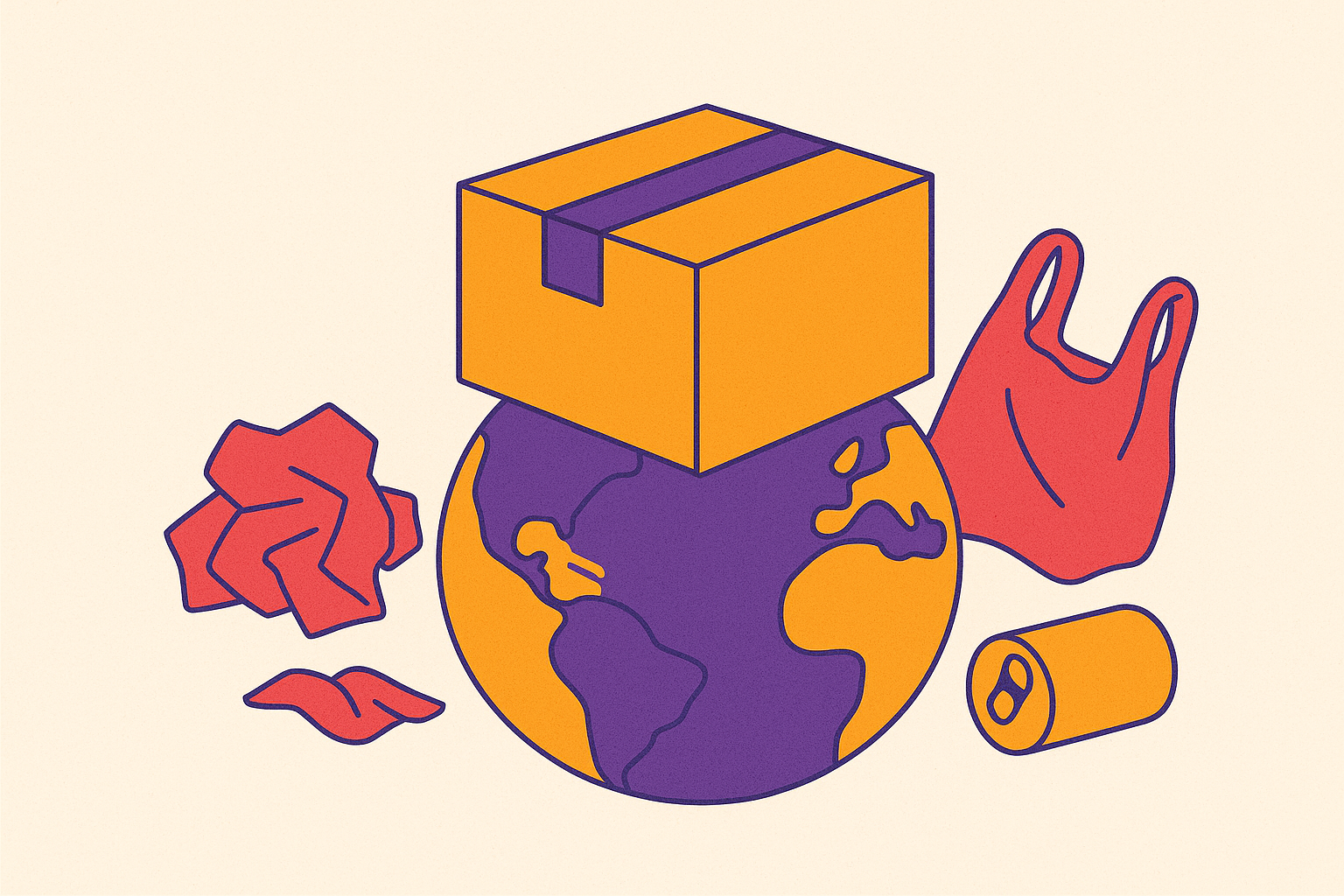
The surge in online peer-to-peer resale has produced a parallel surge in small-parcel shipments, and every one of those boxes carries a packaging cost that most sellers never stop to add up. Global parcel volume hit roughly 167 billion shipments in 2023, and resale between individuals is a growing slice of that number. That figure is expected to reach 200 billion parcels by the end of 2025. That's not a typo. Billion, with a b.
Think about what actually goes into a single shipped item. There's the outer box or mailer, then void fill to keep things from rattling around, then whatever the product itself came wrapped in, and sometimes a layer of bubble wrap or tissue on top of that for good measure. Multiplying that by a jacket sold on Depop, a phone case sold on eBay, and a lamp sold on Vinted starts to reveal the shape of the problem. Online shopping, as a category, produces meaningfully more packaging waste than walking into a store and carrying something out under your arm. Online shopping is said to generate 4.8 times more packaging than brick-and-mortar stores.
Sellers have whatever's lying around the house, a roll of tape, and a deadline before the buyer starts asking where their package is. It's simply a structural side effect. It's just what happens when millions of individual, untrained shippers become a logistics network overnight. P2P sellers, unlike retailers, have no packaging department, no sustainability team, and no EPR obligation, so they reach for whatever is at hand.
The genuine environmental case for resale
Before picking apart resale's packaging problem, it's worth being straight about what resale actually gets right. A 2025 study on secondhand smartphones found that each resale transaction meaningfully extends how long a device stays in use, and the buyer ends up with a 34% lower annual carbon footprint as a result. That's a substantial figure. It's the kind of gain that happens when you avoid manufacturing a brand-new phone, which is a genuinely carbon-heavy process, mining and refining and assembly and all of it.
That's the mechanism in a nutshell: for durable goods with a lot of embodied carbon baked into their manufacturing, the emissions saved by not building a new one tend to swamp the emissions cost of shipping the used one across the country. The secondhand market overall is worth hundreds of billions of dollars now and it's growing faster than retail, so the potential scale of that displacement effect could move numbers significantly. It's a market big enough to move numbers.
The cleanest version of this story, though, doesn't involve a box at all. Local pickup, the kind that happens on Facebook Marketplace for furniture, appliances, and other bulky stuff, skips packaging and shipping entirely while still extending the product's life. No mailer, no void fill, no delivery truck. Roughly half to most secondhand transactions happen informally between individuals, a large share involving no shipping at all. That's the resale channel nobody talks about at conferences, mostly because there's no packaging company sponsoring the panel. It's also the version of resale that has the strongest environmental case, hands down, and it's chronically undercounted whenever people compare resale to retail.
Rebound effects and packaging reality: where the environmental math breaks down
The benefit doesn't hold up quite as cleanly once you factor in two things that resale's biggest fans tend to skip over: how people actually behave, and what actually happens to the packaging.
Start with behavior. Research co-authored by Yale's Meital Peleg Mizrachi found that people who buy secondhand clothing frequently also tend to be heavy buyers of new clothing. Mizrachi said, "rather than solving the problem of overconsumption, secondary markets may inadvertently encourage unsustainable purchasing patterns". In other words, the thrift haul doesn't replace the fast-fashion haul. It sits right next to it in the closet. Fast fashion has nearly doubled global garment production over the past 20 years, and resale income, plus the psychological license of feeling like a "sustainable shopper," appears to help fund additional new consumption rather than less. The smartphone study ran into a version of the same wall: once you look at realistic, modest adoption levels, the shortened use times that come with more frequent device-swapping eat into a good chunk of the potential carbon savings.
Then there's the physical side, which is a separate problem entirely. Protective plastic and poly bags are the two most common plastic types in e-commerce packaging, with protective plastic the single biggest offender, and both are a headache for recycling systems that mostly aren't built to handle them. Only a small slice of all plastic waste gets recycled globally in the first place. Some 91% of all plastic packaging waste eventually ends up in landfills or polluting the environment. Returns make things worse: shipping something back adds delivery emissions on top of the original trip, and returns processing adds its own chunk to the shipping industry's total footprint. Most of the packaging waste generated by e-commerce returns ends up in a landfill, full stop.
These two problems, the behavioral one and the physical one, don't cause each other. A seller can pack a box thoughtfully and still be part of a market that's quietly fueling more new consumption. Or someone can buy nothing new all year and still generate a pile of poly mailers. Fixing one doesn't fix the other.
The regulatory blind spot for individual P2P sellers
The rules that are pushing big companies toward better packaging simply don't apply to a person listing a used sweater on an app.
The EU's Packaging and Packaging Waste Regulation, which replaced the old Directive as of 12 August 2026, requires all packaging to be recyclable by 2030, with material-specific obligations for economic operators, but individual eBay or Facebook Marketplace sellers in the EU face no parallel obligation. That regulation sets a minimum 70% overall recycling target by 2030, with material-specific targets of 85% for paper/cardboard, 80% for ferrous metals, 75% for glass, 60% for aluminium, 55% for plastics, and 30% for wood, and it does not harmonize penalties at the EU level, leaving Member States to set their own.
The marketplaces themselves aren't stepping in to close that gap, either. Neither eBay nor Depop, which eBay agreed to acquire in a deal announced in February 2026 and closed that July, requires individual sellers to use sustainable packaging. Vinted runs on a zero-seller-fee model, which sounds great for sellers' wallets but also means there's even less financial cushion for anyone to absorb the extra cost of eco-friendly packaging materials.
None of this is a scandal or some kind of oversight waiting to be corrected. It's just how the regulatory math shakes out when a law is written for producers and factories, and gets applied to a market made up of millions of individuals shipping one or two items a month. Nobody's coming to make sellers pack better. Whatever changes, changes because the seller decided to change it. In the U.S., seven states have passed EPR packaging legislation as of 2025 (Maine, Oregon, Colorado, California, Maryland, Minnesota, and New Jersey), targeting producers, not individuals. US businesses spend an estimated $7 billion each year managing plastic packaging waste, costs that appear as landfill surcharges, inefficient material handling expenses, and regulatory fees rather than on a purchase order.
The "reusable packaging" solution is less straightforward than it sounds
The advice a lot of well-meaning sellers land on is "just buy reusable packaging." Sounds simple enough, but it's not the free win it's cracked up to be, because reusable materials only pay off if they actually get reused a lot.
Take a durable polypropylene shipping box. It has a bigger production footprint than a plain cardboard box right out of the gate. Run through 20 shipping cycles, a durable polypropylene box comes out well ahead on the environmental math. At three return cycles before loss or discard, a durable polypropylene shipping box may not deliver a net environmental benefit, though at 20 return cycles it delivers a strong one. "Reusable" is not a synonym for "greener." It depends entirely on what happens after the first use.
That's exactly the problem for someone selling occasionally on the side. Retailers can build systems that track and recirculate reusable packaging because they're shipping thousands of units a week. A person selling a couch and a stroller every few months has no such system, and no way to guarantee the box comes back for another lap. Biodegradable and compostable mailers carry a similar catch: they need industrial composting to actually break down. Toss one in a regular landfill and it sits there behaving almost exactly like ordinary plastic. Good intentions, wrong ending. A comparative carbon footprint analysis found that polyester reusable packaging generates significantly more CO₂ emissions than cardboard in production and waste management (ScienceDirect), meaning "reusable" is not automatically greener.
Packaging choices that reduce waste for a typical resale shipment
Skip the shopping cart. The most effective packaging choices for a sporadic seller don't involve buying anything new at all, they involve using better judgment with what's already on hand.
Size the box to the item, not to whatever's closest on the shelf. Oversized boxes are discussed as one of several drivers of avoidable packaging waste, alongside inefficient routing and poor material choices. A too-big box needs more void fill to stop things from shifting, weighs more, costs more to ship, and wastes more material for no reason. Right-sizing is the single biggest lever most sellers are ignoring. After that, reuse: boxes and mailers already sitting in a closet or a recycling pile are the highest-impact option available to a casual seller, because they cost nothing and skip the production footprint of anything new entirely. This is actually where individual sellers have an edge over big retailers. Most households already have a steady stream of incoming cardboard from their own online orders, sitting there waiting to be flattened and forgotten. Give it a second life instead.
If new packaging is unavoidable, recycled-content paper mailers beat virgin poly mailers on both production carbon and what happens to them afterward, since most municipal recycling systems can actually process paper. For cushioning, crumpled paper from a recycled source does the job better than bubble wrap or foam peanuts for most lightweight items, and it's curbside recyclable where bubble wrap generally isn't.
For anything bulky, furniture, appliances, baby gear, local pickup through something like Facebook Marketplace isn't a fallback option, it's the right call. It skips packaging and transport emissions completely. And one choice that has nothing to do with tape or boxes at all: listing accurately the first time. A return means the item gets boxed up and shipped twice, doubling the packaging and the transport emissions for a single sale. Getting the description, condition, and price right the first time, the kind of accuracy that tools built for comparing real sold listings can help sellers nail down, is a packaging decision even though it doesn't look like one.
Thinking about the tradeoff honestly before you ship
Resale is still, on balance, a good thing to do environmentally. But it's not a free pass, and treating it like one is how packaging waste sneaks up on an entire industry while everyone's congratulating themselves for not buying new.
The math tilts most favorably when the item has a lot of embodied carbon locked into it, electronics, appliances, well-made clothing built to last, and the packaging around it stays minimal. In those cases, avoiding new manufacturing does the heavy lifting and easily covers the cost of a reasonably packed box. The math gets tighter with cheap, lightweight, fast-fashion items, where shipping and packaging can eat up a real chunk of whatever environmental benefit resale was supposed to deliver.
Local pickup remains the cleanest version of all of this, no packaging, no delivery truck, full life extension for the product, and it's an option for more items than most sellers ever consider. Nobody's coming to legislate better behavior out of individual sellers anytime soon, and that gap isn't closing fast. So the choices that matter fall on the person taping up the box: how much they pack, what they pack it in, whether the listing is accurate enough that it doesn't boomerang back as a return, and whether pickup was ever on the table to begin with. None of those choices cost much. All of them add up.
Sources
- Environmental Cost of Packaging Waste | Key Impacts
- The True Cost of Plastic Free Packaging – EcoPackables
- Impact of e-commerce returns: report highlights waste, emissions, and cost hikes | Packaging Europe
- Replacing plastic with corrugated cardboard: A carbon footprint analysis of disposable packaging in a B2B global supply chain—A case study - ScienceDirect
- Second-hand smartphones reduce carbon emissions, yet shorter use times limit actual gains | Communications Earth & Environment