Secondhand Market Size and Growth Projections
The global secondhand market hit $475 billion in 2025 and shows no signs of slowing down.

The secondhand market isn't a fringe economy anymore. It's a mainstream retail channel growing fast enough that sellers holding unwanted items are sitting inside one of the most favorable markets in years. The infrastructure that once made selling used goods a chore is gone. What's left is a market that's already huge and still accelerating.
The global secondhand market reached $475.19 billion in 2025. That's not a projection. That's the current base, and ThredUp's 2026 Resale Report, produced with GlobalData, projects substantial growth through 2030 before any new buyer enters the market. You don't need to squint at the numbers. This is a market roughly the size of a major national economy, trading entirely in things people already own.
Different analysts slice the market differently, which is why you'll see figures that don't match. Peer-to-peer platforms, formal recommerce businesses, traditional thrift stores, and donation channels all count but get measured separately. What matters is the split inside the U.S. figure: resale through platforms and peer-to-peer channels already accounts for more than half of the total secondhand market. Traditional thrift and donation make up the remainder. The digital side has already overtaken the analog one.
eBay puts a concrete number on what this looks like at platform scale. Pre-loved and refurbished goods have represented more than 40% of eBay's gross merchandise volume since Q1 2024, when CEO Jamie Iannone called reaching that mark a major milestone. On a marketplace that large, resale isn't a side category. It's the main event.
The trajectory from here is even steeper. The secondhand product market is projected to reach $535.03 billion in 2026. That's a jump of tens of billions of dollars in a single year. You are not looking at a plateau. You are looking at a market adding scale at a rate that would be front-page news in any other retail sector.
Why the market keeps growing — infrastructure, not just sentiment
The secondhand market keeps growing because someone removed all the friction. Not because consumers had a sudden change of heart about their values. The values were always there, at least in some form. What changed is that buying and selling used goods stopped being a hassle.
The recommerce trend analysis identifies three specific friction-removers that turned resale from a weekend habit into a regular retail channel. First, listing from a phone in minutes. That alone killed the biggest barrier. Second, payment and shipping absorbed by the platform. No more trips to the post office or haggling over cash. Third, buyer protection that made purchasing risk small enough to ignore. Once those three pieces clicked into place, the whole dynamic shifted.
That's when the standard marketplace flywheel took over. More listings attract more buyers. More buyers attract more sellers. Selection deepens on its own, which brings in still more buyers. The flywheel runs without any external push. That's what makes this a structural shift rather than a trend. Trends need enthusiasm to sustain them. Flywheels just need to keep spinning.
The clearest evidence of infrastructure as the driving force is the growth gap between digital resale and traditional thrift. Resale has grown more than seventeen times faster than thrift since 2018. Seventeen times. Both channels sell used goods to similar customers with similar budgets. The only meaningful difference between them is digital infrastructure. Same goods, same motivations, radically different growth rates. The mechanism is the market itself now, not a wave of sentiment.
The demand forces that are pulling buyers into the secondhand market in 2026
Three demand forces are converging in 2026, and they're not weighted equally. The first is economic pressure. The second is generational habit. The third is sustainability preference. The order matters because it tells you who's buying and why.
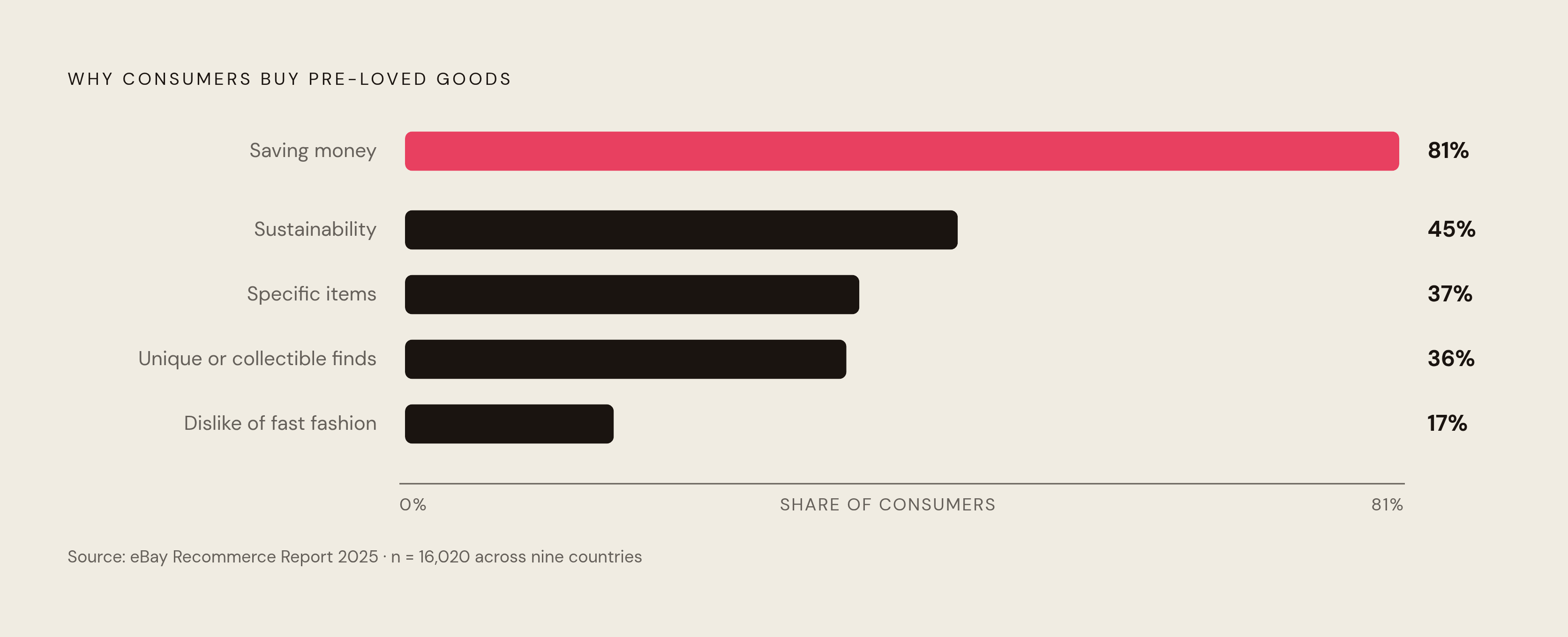
Price is the dominant motivation by a wide margin. eBay's 2025 Recommerce Report surveyed 16,020 consumers across nine countries and found that 81% named saving money as a reason to buy pre-loved goods. Sustainability came in at 45%. Specific items at 37%. Unique or collectible finds at 36%. Dislike of fast fashion trailed at 17%. The message to sellers is clear: your buyers are price-motivated and numerous. They're not niche idealists hunting for vintage treasures. They're people looking for a deal, and there are a lot of them.
The second force is generational, and it's the one that makes this durable. Gen Z and Millennials are expected to account for the majority of U.S. resale growth through 2030, per ThredUp's 2026 Resale Report. This isn't a price blip tied to one bad inflation cycle. It's a cohort that grew up buying used and sees nothing unusual about it. They don't need to overcome a stigma their parents carried. For them, buying secondhand is just shopping.
Sustainability operates as a secondary accelerant, and it's worth being precise about what that means. The 45% figure from eBay's survey shows a substantial minority of consumers name sustainability as a reason to buy used. That share is large enough to remove hesitation once price already works. In other words, sustainability tips people over the edge, but price gets them to the ledge. The recommerce trend analysis frames it this way, and it matches what the data shows. Don't overstate the green motivation. Don't dismiss it either.
The secondhand market is expected to grow at a strong compound annual rate in 2026. All three of these forces are pushing in the same direction at once. That's what makes this moment unusual. You don't often get economic pressure, demographic shift, and value alignment all working the same lever at the same time.
Why apparel is the clearest proof that resale is outrunning new retail
Apparel is where the data is richest, and the numbers tell a story that should unsettle anyone in traditional retail. Secondhand clothing isn't tracking alongside new clothing sales. It's replacing a share of them.
U.S. secondhand apparel grew close to four times faster than clothing retail as a whole during 2025. That's per ThredUp's 2026 Resale Report. Four times faster, same category, same year. The gap isn't marginal. It's the difference between a market that's growing and one that's treading water.
The forward-looking numbers are even more stark. Resale is expected to outpace new clothing purchases at roughly two to one globally over the next five years. In the U.S., the projection is four times faster. That's a directional shift in where clothing dollars are going. A dollar spent on used clothing is a dollar not spent on new clothing. When the used side is growing at four times the rate of the new side, the share is moving. The movement is structural, and it compounds.
Apparel is the clearest proof because it's the most mature secondhand category. The infrastructure came online there first, the buyer habits formed there first, and the growth gap is widest there. But the forces driving that gap aren't specific to clothes. They're the same infrastructure and demand dynamics operating across every category where people own things they no longer use.
What the growth trajectory means for sellers holding items in other categories
If you're holding a closet full of clothes, the argument above lands naturally. But the same structural forces are operating across electronics, toys, furniture, and home goods. Whatever category of stuff you own, a buyer pool that is larger and more active than ever is looking for it.
Think about electronics. A used laptop, a previous-generation phone, a gaming console nobody touches anymore. These items have always had resale value, but the friction of selling them used to swallow the return. Now the listing takes minutes and the payment is handled. The buyer is protected. The transaction closes.
Toys follow the same pattern. Kids outgrow things fast, and parents hold inventory that has a defined lifespan. Used toys in good condition have genuine demand. The infrastructure that moves them is the same infrastructure that moves used sweaters. Furniture and home goods are heavier and harder to ship, which historically made them thrift-store territory. That's changing as platforms handle more of the logistics.
The supply side is not small. The average American household holds a significant amount in unused items. That inventory has been sitting there for years because selling it used to be work. The market has grown structurally larger than at any prior point. The buyers are there. The tools are there. What's been missing is people treating their unused stuff as inventory waiting for a channel, and that channel now exists.
The secondhand product market reached $475.19 billion in 2025 and is projected to hit $535.03 billion in 2026. That growth is not confined to one category. It's the whole market expanding, which means the expansion touches every category where people list things.
Why sellers who list now are operating with structural tailwinds behind them
A growing market with more buyers and better infrastructure sounds like a gift to anyone holding inventory. But it doesn't automatically benefit sellers who guess at prices or delay listing. Capturing the opportunity requires meeting the market where it is.
More buyers means more competition among sellers. That's the part that gets left out of the upbeat story. The same infrastructure that brought buyers in also brought other sellers in. Accurate pricing based on real sold data, not asking prices or gut feeling, is increasingly the difference between a listing that sells and one that stalls. A price that's too high sits untouched. A price that's too low leaves money on the table. The sold data is the only reliable guide, and it exists now in a way it didn't a decade ago.
Listing friction is the practical barrier that keeps most casual sellers from acting. It's the same problem, just moved from the market level to the personal level. The infrastructure improvements that brought buyers into the market, fast listing, integrated shipping, built-in payment, are the same tools sellers need to match buyer expectations. The tools exist. They're widespread. What's been missing for most people is the will to start.
AI-assisted listing tools attack this friction directly. Tools that handle item identification, condition grading, and description writing remove the parts of listing that feel like expertise. Tools like Reclaim make the process accessible to a first-time seller without requiring the pricing knowledge a seasoned reseller has built over years. That's the honest framing: the tool exists to close the gap between a beginner and an expert, not to promise anything the market doesn't offer.
The market is growing in sellers' favor. What holds most people back is not opportunity but the perceived work of getting started. That barrier is smaller now than it has ever been. The sellers who act while the market is in this growth phase are the ones who benefit most from it. The flywheel is spinning. The buyers are there. The friction is gone. What you do with that is the only open question.