Sneaker Resale Culture and Its Mainstream Crossover
Authenticated platforms and wider taste have made sneaker resale rational commerce.
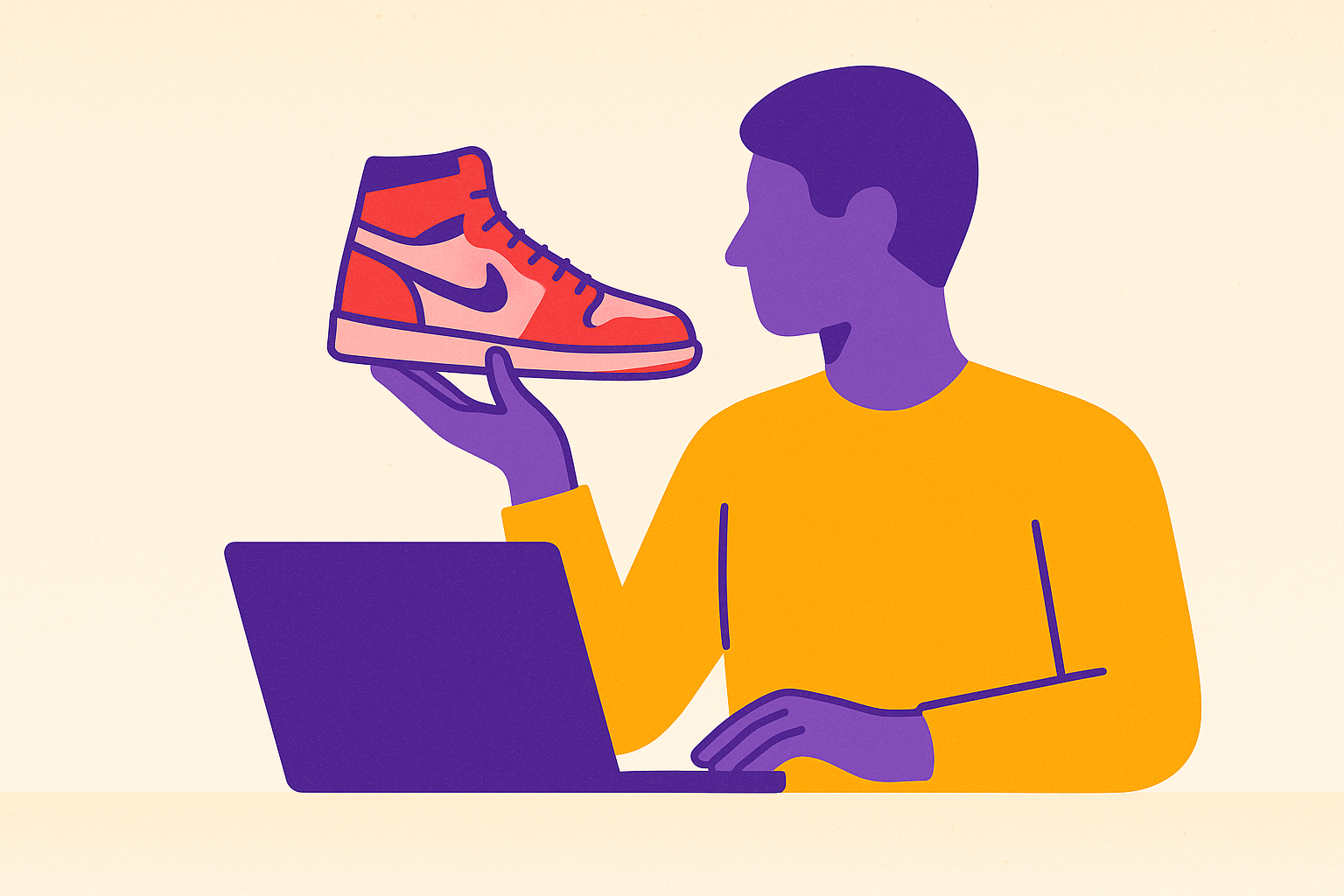
Sneaker resale has crossed from an insider hustle into mainstream commerce. Ordinary sellers can now find real prices, reach buyers, and use platforms that handle authentication. The easy-money era has faded. In its place is a more durable secondary market, where selling shoes need not become a second job.
How sneaker resale grew from a niche hustle into a recognized secondary market
Sneaker resale began as a closed loop built on artificial scarcity and insider knowledge. Limited releases rewarded people with early access, good connections, and the speed to buy before everyone else. Casual buyers lacked those advantages, so the outsized margins were difficult to replicate. Knowing which pair mattered was only half the job. Knowing how to get it was the velvet rope.
What changed that structure was not simply buyers growing tired of hype. StockX, GOAT, and eBay's Authenticity Guarantee made it easier to search and understand a peer-to-peer trade where trust was hard to come by. Authenticated marketplaces gave strangers a way to transact without building a personal relationship first.
The market that emerged: size, growth, and what it tells us about staying power
DataM Intelligence projects the global sneaker resale market growing at a 10.1% CAGR through 2035, faster than the broader primary sneaker market. North America has the largest share of the market by region, and Asia-Pacific is growing the fastest. The infrastructure supporting resale is therefore global. response to sneaker fever.
The enormous primary sneaker market also gives resale a deep, continually replenished pool of inventory. StockX and GOAT Group together have tens of millions of registered users, which puts them well within the mainstream of how people shop. Resale has become a route through which goods circulate. That still leaves a harder question, which is who can profit from using it.
Why margins compressed and what that actually means for the resale economy
Fewer than half of new releases now trade above retail, and typical margins have fallen sharply from the outsized returns that once defined the hobby. Scarcity no longer gives every release a dependable profit cushion.
With less to make on each pair, serious resellers have had to sell more pairs. That takes bot access, wholesale pricing, inventory management for a range of products, and a good reputation on the platform. For ordinary sellers, however, the same correction has made resale more rational. Discoverable prices, reliable platforms, and lower listing barriers are useful even when spectacular markups are not on offer.
How brand heat shifted from Nike and Jordan to ASICS, Salomon, and Mizuno
The redistribution of brand heat makes this change visible. ASICS and other athletic and lifestyle crossover labels are part of a shift driven by Generation Z buyers who value functional versatility over hype. StockX's 2025 trends report states that the ASICS Gel-1130 in Black/Pure Silver held the top spot as the platform's best-selling sneaker in 2025. That is a concrete sign that resale demand extends beyond the names that once dominated it. A shoe can earn attention because it fits someone's life.
This diversification leaves room for Nike and Jordan, as Nike's rebound entering 2026 and the dramatic search spike produced by the Levi's x Nike collaboration show. Cultural taste now shapes resale demand more than manufactured scarcity alone. That makes demand harder to predict from the outside, but creates openings for sellers holding pairs that have moved from unfashionable to fashionable.
How authentication infrastructure turned platform trust from a promise into a competitive feature
Broader taste could bring more buyers into resale, but platforms still had to make transactions with strangers credible. Their central promise was straightforward, namely that buyers would receive what they paid for. Delivering on it required authentication infrastructure that the earlier peer-to-peer market lacked.
The platforms widened participation in different ways. StockX at first required deadstock pairs with original boxes, while GOAT used its own condition grading to make room for used and pre-owned pairs. That let sellers with worn pairs use an authenticated marketplace, and eBay's Authenticity Guarantee brought authentication to the platform that already had the most buyers, checking sneakers above a minimum price threshold through third-party partners including Sneaker Con.
Why counterfeits remain the structural threat that authentication has not fully solved
Authentication matters precisely because counterfeiting has professionalized too. The counterfeit sneaker industry is a multi-billion-dollar global operation with sophisticated factories and supply chains. Its highest-quality “super fake” products can defeat visual inspection by most buyers and many platform authenticators.
StockX's own brand protection data shows how much work goes into screening: in a recent year, it rejected hundreds of thousands of products, including tens of thousands of suspected counterfeit sneakers worth millions of dollars. StockX's Detroit Innovation Lab has extended authentication to CT scans and scent analysis. Nike published a patent application in early February 2026 for manufacturing-based digital authentication using visually imperceptible patterns, conductive inks, magnetic materials, and encoded grayscale color grids readable by an authorized app. A patent application is not universal protection.
The gap is especially consequential outside authenticated platforms. Social media sellers, Facebook Marketplace, and OfferUp are high-risk routes because they lack the sneaker authentication layer that these marketplaces provide. For unprotected transactions, PayPal Goods and Services or a credit card provide dispute recourse, unlike Zelle, Venmo, Cash App, and wire transfers. If authenticity cannot be established through at least two independent methods, the risk is not worth the price.
Who is now buying in the resale market and what their motivations reveal about where it goes
The buyer base is broader, more female, more sustainability-motivated, and less speculative than it was at the hype peak. For a taste-led buyer, the reward is getting the pair they want. For a buyer who cares about sustainability, a secondhand pair in good condition fits the values of the circular economy. Neither motivation requires prices to keep climbing.
The seller base has also split into distinct groups. Volume Collectors buy a handful of pairs per year and use resale to sell them from time to time, while Investment Flippers buy dozens each year with bot access and use spreadsheets for inventory management. Despite the name, the Volume Collector is closer to the casual participant than the full-time operator. That casual seller profile is the larger and faster-growing segment.
How to price a pair accurately using sold data, not asking prices or gut feeling
For an ordinary seller, the first practical task is separating an asking price from a selling price. eBay's Sold Listings filter shows what buyers actually paid. Repeated sales at a lower price last month say more than a collection of ambitious listings today. StockX's highest active bid also shows what a real buyer is willing to pay now.
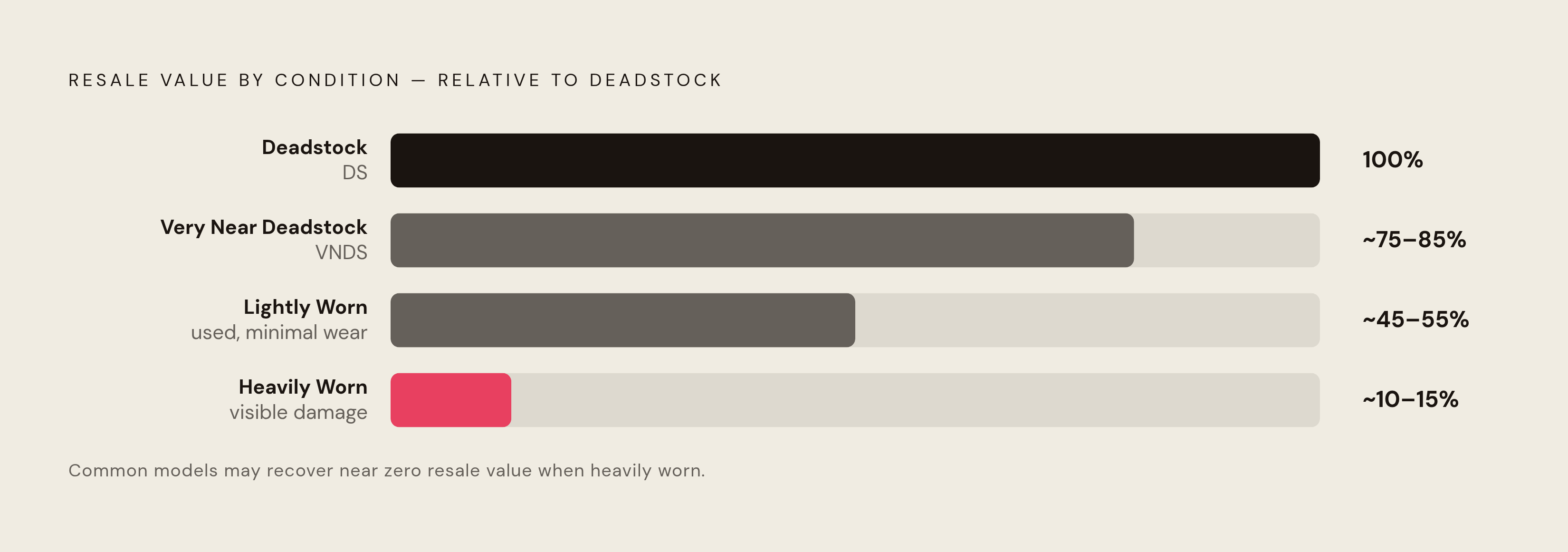
The comparison must also match the pair's condition. Very near deadstock, or VNDS, pairs typically achieve a high fraction of deadstock value, though meaningfully less than a perfect pair. Lightly worn pairs sell for a moderate share of deadstock value, but heavily worn pairs bring only a small share, and common models with that much wear can be worth almost nothing. An OG box with a matching size label adds value and gives buyers an authenticity signal. Missing original packaging also narrows StockX as a channel because its deadstock requirement includes the original box.
Once the market value is clear, fees belong in the calculation. The formula to use is Target Sale Price = (Cost Per Pair + Desired Profit) ÷ (1 − Platform Fee %). It shows the price needed for a chosen profit. AI-assisted listing tools can shorten the research by turning a photo into an identification, condition grade, and price anchor drawn from real sold data. That is a useful starting workflow, while the transaction evidence remains the basis for pricing.
Which platform fits which pair: matching the sneaker to the right marketplace
Platform choice follows from the pair's condition, the fees, and how quickly the seller wants to sell. StockX suits brand-new, unworn sneakers with the original box. Its bid/ask model allows an immediate sale when the seller matches the highest bid, and the platform handles authentication. Fees vary by seller level, so the headline sale price is not the take-home amount. Speed has to be weighed against that net payout.
GOAT works for pairs that have damaged boxes, small factory defects, or signs of use. Its standardized condition grading discloses those differences to buyers, while its fees include a percentage commission and a cash-out fee. eBay offers a versatile route and serves as an anchor for many volume-oriented resellers. Its Authenticity Guarantee applies above a minimum price threshold, fees vary by category and seller level, and Sold Listings keeps pricing research within the marketplace.
Poshmark's flat fee structure gives it the highest fees for sneakers among these choices, which takes a larger bite out of sales of valuable pairs. Still, its many buyers who shop for fashion can be a good fit for lifestyle and women's styles. Listing across marketplaces can reach different buyers, but it introduces inventory sync risk. When a pair sells on eBay, it must be delisted at once everywhere else, including StockX, where selling a pair that is no longer available can lead to a penalty fee and hurt the seller's metrics. Inventory management tools built for this job help keep listings in sync, while sellers who do it by hand need to make delisting part of each sale.
What the maturation of sneaker resale means for an ordinary seller deciding whether to participate
A decade of maturation has largely dismantled the structural barriers that once kept ordinary sellers out. Real transaction data makes pricing discoverable, authenticated platforms handle much of the trust burden, and photo-based tools reduce the knowledge needed to start a listing. A profitable sale is still far from certain. They do make participation manageable without first becoming a sneaker specialist. That is a more useful kind of access than a promise of easy money.
Betting on pairs for high margins still takes infrastructure that casual sellers can do without and do not have. Clearing out a closet is not the same business as managing wholesale inventory, and sustainability-minded buyers create genuine demand for secondhand pairs in good condition. An ordinary seller does not have to reproduce the speculative peak or operate like an Investment Flipper to serve that demand. The opportunity is simpler and more grounded, with real buyers, visible prices, and platforms built to support the exchange.