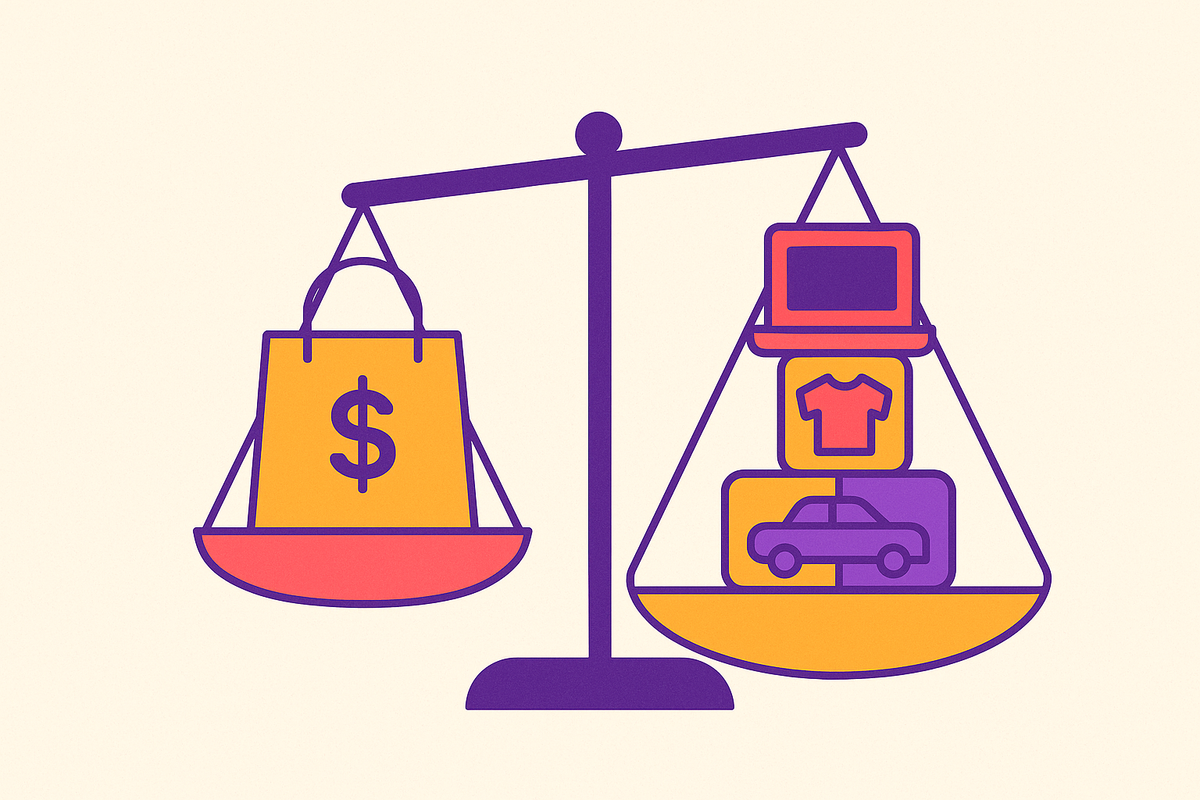
How Much Money the Average Home Has in Unused Items
Thousands of dollars in resale value is hiding in your closet, garage, and junk drawer.
The average American home holds roughly 300,000 individual items, and most of them just sit there. This piece is about what that stuff is actually worth in dollars, where it's hiding room by room, and how to turn it into cash without losing a weekend to the process.
What the average American home contains in unused items
Three hundred thousand items sounds like a typo until you count. Paper clips, hangers, half the junk drawer, the extension cords you own three of. Most of that pile never gets touched. Research from the National Association of Professional Organizers backs this up directly: the clothes, electronics, and household goods most people own mostly sit untouched for years, not days.
The self-storage industry is basically proof of this at scale. The U.S. has built an enormous number of facilities just to hold the overflow, and even that isn't enough room. One in four people with a two-car garage can't fit a single car inside it because of stored belongings. That's a warehouse with a basketball hoop bolted to the front of it, not a garage anymore.
Surveys show Americans regularly spend real money on items they end up regretting or never using. Steady overbuying combined with almost nothing getting sold off turns a home into a one-way valve. Stuff goes in constantly. Almost nothing comes back out. Before getting to what any of it is worth, it helps to just sit with the shape of the pile: a house is less a living space and more a long-term storage unit that happens to have a couch in it.
The dollar value sitting in unused household items
The scale turns into a money question, and the money question is bigger than most people expect. One widely cited estimate puts the unused items sitting in the average household at more than $93 billion nationally, a conservative figure, because a typical home holds a few dozen unused items.
A more recent set of resale-focused reports puts the per-household figure much higher, into the thousands of dollars for a single home. Line those two estimates up next to each other: the gap means people are sitting on more value than they think, and have been undercounting it for years, largely because they've never checked what their items actually sell for.
A donation fair-market-value guide gives you a useful floor you can compare against. Those guides assign modest values to things like working flat-screen TVs, laptops, and video games, the kind of number you'd write on a tax form for a charitable deduction. Marketplace resale should clear those numbers on nearly everything, because a donation valuation reflects what the IRS will accept, not what a buyer will actually pay. The real argument of this piece sits right here: the problem was never a shortage of sellable stuff. Almost nobody has priced what they own against what it's actually selling for today.
Where the money is concentrated, by room and category
Unused value doesn't spread evenly across a house. It clusters into a short list of predictable categories, which makes a home audit a lot less overwhelming than it sounds.
Electronics carry some of the biggest numbers. A 2018 survey put unused home technology at an estimated $33 billion nationally, and that was before tariffs pushed new electronics prices up, so used tech looks even better by comparison now. Most surveyed households had more than two unused cell phones sitting around, along with cameras, old PCs, consoles, tablets, and MP3 players that have sat untouched for years.
Closets hold a similar story. Many women carry a surprising amount of value in clothing that's just hanging there, and a smaller share are sitting on genuinely large sums without realizing it. The average American throws away a significant amount of clothing every year, and most of it had resale value long before it hit a donation bin or a landfill. Throwing it away is basically lighting a small match and holding it under a stack of cash.
Game consoles, controllers, and games move fast in resale markets. Demand stays steady year-round and shipping is simple, so you can turn this category into cash quicker than almost anything else in the house. Small kitchen appliances follow a similar pattern. Air fryers, espresso machines, and higher-end blenders get searched for constantly by buyers. Solid wood furniture and mid-century pieces hold value well, and they tend to move locally. The garage adds its own category: tools, lawn equipment, bicycles, camping gear. Sellers there are often just trying to reclaim space, which creates motivated pricing that buyers specifically look for.
There's also a smaller, odder lane: working older electronics like VCR/DVD combos and certain portable audio players have real resale demand right now, and retired LEGO sets can sell for a wide range depending on which set it is. Nostalgia, it turns out, has a price tag.
As a general rule, you can sell used household items for a meaningful fraction of their original retail price. Electronics lose value fastest. Furniture, tools, and sporting equipment hold their worth considerably longer.
Why most people underestimate what their items are worth
A 2019 study found the real obstacle is a pattern it called "low sell-esteem": most people believe selling takes too long, that nobody wants their stuff, and that their items are worthless. All three beliefs are usually wrong, and all three keep perfectly good items parked in a closet instead of in someone else's cart.
The top reasons people gave for not selling lined up closely: not knowing what an item is worth, not having enough time, assuming the item has no value, and not wanting to deal with meeting a stranger. The 2018 tech survey backs up the first reason with a specific number: 32 percent of people didn't even know trading in old tech for money was an option. The knowledge gap is fixable with about thirty seconds of searching.
Pricing confusion makes the gap worse. People see an asking price on a listing and assume that's what the item is worth. An asking price is just what a seller hopes to get. It says nothing about what buyers are actually paying. The only reliable signal is a sold listing, where money has already changed hands. eBay's sold and completed filter shows exactly that: real transaction prices on identical or near-identical items. Facebook Marketplace doesn't show sold prices publicly the way eBay does, which is part of why items there so often get mispriced in both directions, too high and too low, sometimes on the same day in the same category.
Even people who clear the pricing hurdle often stall at the next one: friction. Researching an item, writing a description, taking decent photos, picking the right platform, all of that adds up to real effort per item, and effort is what gets deferred to "this weekend" indefinitely. AI-assisted tools have started closing that gap directly. Apps now let you snap a single photo, pull real eBay sold data automatically, and generate a working listing, so you skip what would otherwise be a chunk of manual research time per item. That's the behavioral fix for a problem that was never really about motivation. It was about the ten minutes of friction standing between "I should sell this" and actually doing it.
The ongoing cost of leaving unused items in place
Keeping unused stuff is an active, ongoing expense across three fronts: money, time, and the value of the home itself.
On the money side, Americans collectively spend billions replacing items they already own but can't locate, and plenty of people pay monthly storage fees, often running into the hundreds of dollars a month, just to house things they're not using. That's rent paid on boxes.
On the time side, the average person spends 2.5 days a year looking for misplaced items. Two and a half full days, every year, hunting for a charger or a specific pair of shoes buried somewhere in an overstuffed closet. It's an annual scavenger hunt nobody signed up for and nobody wins.
Clutter also touches home value directly. A cluttered house can affect sale price and buyer perception when it's time to list a property, adding a financial angle for anyone planning to sell down the road. The costs compound: storage fees for things not being used, hours lost searching for items buried under other items, and the steady depreciation that keeps eating into resale value the longer anything sits. Every month something stays in a closet instead of a buyer's hands, is a month it's worth a little less.
Turning the inventory in your home into actual cash
Capturing that value comes down to three steps done in order: know what's actually in the house, price it against real sold data, and send each item to the platform where its buyer is already shopping.
Start with a room-by-room pass through the categories that carry the most value. Electronics and gaming gear usually cluster in the bedroom, living room, and garage. Clothing and accessories live in closets. Small appliances sit in the kitchen and pantry. Tools and outdoor gear pile up in the garage. Walking through with that short list in mind turns a vague "I should declutter" into a concrete checklist.
For rough starting prices, the 50-30-10 framework works as a quick first pass: like-new condition around half of retail price, used condition around a third, well-loved condition around a tenth. Treat those as starting points, not final numbers, and check them against actual sold listings before you settle on a price.
Pricing itself should come from sold data, never asking prices. Search the item on eBay, filter to sold and completed listings, and use that median as the real number. Adding a modest buffer above that median leaves room to negotiate, especially on Facebook Marketplace, where buyers routinely make offers below the list price. Anyone who's completed at least one sale on eBay also gets free access to the Product Research tool (formerly called Terapeak) inside Seller Hub, which extends that pricing lookback across years of sales history for a much deeper read on where prices actually land.
Matching the item to the right platform matters as much as the price does. Furniture, large appliances, and anything bulky tend to do best on Facebook Marketplace, because local pickup avoids shipping and in-person transactions carry no fee. Designer and branded clothing fits better on Poshmark, which charges a flat fee below a low sales threshold and a percentage commission above it, or on Depop, which charges no seller commission in the US and UK beyond a standard payment processing fee and draws a strong Gen Z and streetwear crowd.
Safety matters just as much as pricing. For in-person sales, cash is still the simplest and safest option. For anything shipped, stay inside the platform's own payment system, Facebook checkout or eBay's managed payments. Buyers who push for Zelle, Venmo outside the platform, wire transfers, or gift cards are running a well-documented scam pattern, common enough to treat as a hard rule. Photograph every item before you ship it, including any serial numbers and the packaging itself. That documentation is the main defense against a false "item not received" claim.
The listing itself closes the loop. Clear photos taken in natural light, including any flaws, an accurate description with the brand name and model number, and honest language about condition all cut down on disputes and help the item actually sell. If you find writing the description the hardest part, AI-generated listings can now handle that step for you, pulling the same sold data used for pricing straight into usable listing copy.
None of this requires becoming a full-time reseller. It requires one room, one eBay search filtered to sold listings, and about fifteen minutes to decide this closet has more cash in it than the weekend plans do.