What Casual Sellers Actually Earn From Decluttering
Fees and shipping eat half the profit, so pricing research matters more than listing volume.

Decluttering a home and reselling what's inside can realistically bring in $200 to $800 a month. That number deserves to be taken seriously, even though it won't cover rent on its own. The viral, highly-promoted version of reselling, the one with a garage full of boxes and a screenshot of a five-figure month, belongs to someone sourcing inventory full time, buying low with the intent to flip. That's a different job with a different cost base and a different time budget. A person clearing out a closet and a garage is working with what they already own, nothing more, nothing less, and the honest number for that person is in the hundreds, not the thousands. The secondhand market has grown into a mainstream place people shop, not a niche for bargain hunters, so there's real buyer demand for ordinary household stuff at ordinary prices. What keeps the number modest is simple: a house only has so much stuff in it, there's no discount from buying smart since nothing was bought to resell in the first place, and most people doing this are doing it for the first time. Those three things cap what a casual seller can expect, unless they put in extra hours.
What fees and shipping leave in your pocket
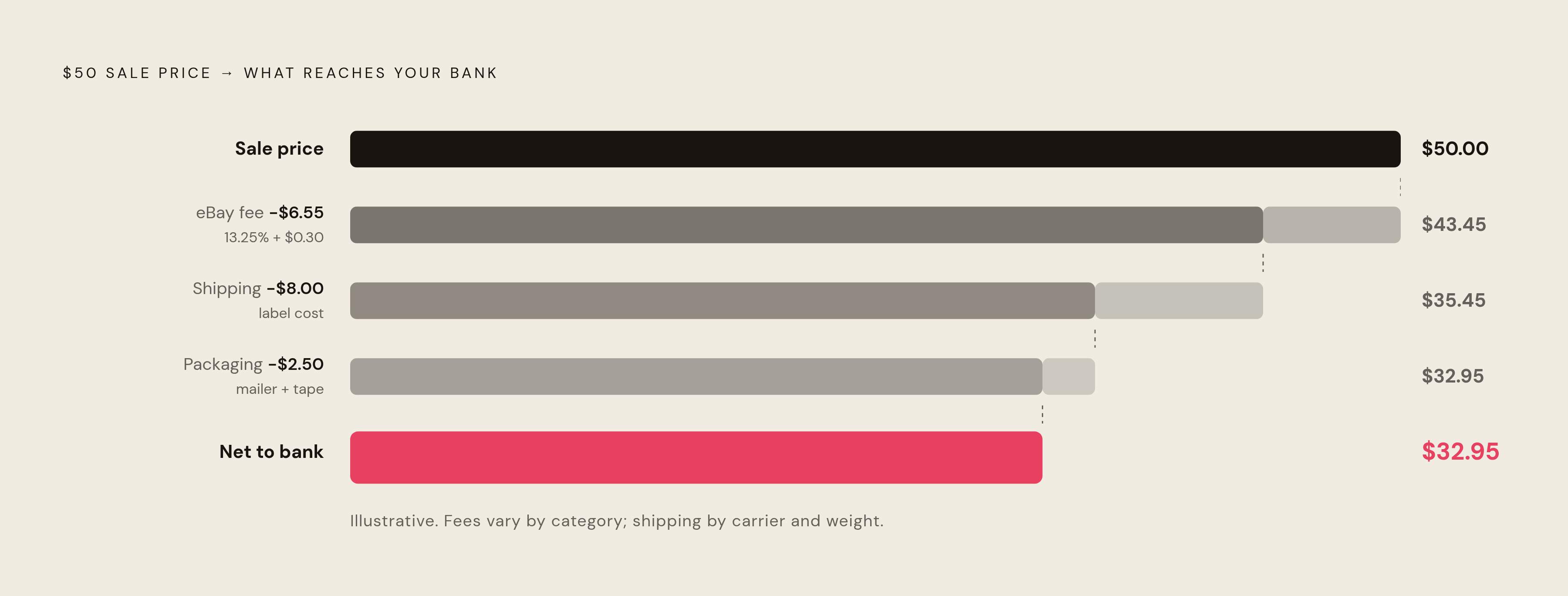
The biggest mistake a casual seller makes is treating the sale price as the payday. A $50 sale is not $50 in the bank, and the number that actually matters is what's left once the platform, the box, and the postage all take their cut. Picture a $50 item sold on eBay. eBay takes a Final Value Fee off the top, a cut of the sale price that applies to basically everything sold on the platform, plus a small per-order charge added on top of that. Then shipping comes out, a cost that depends on weight and size but rarely disappears entirely, even for small items. Add a few dollars for packaging, a mailer or a box and some tape, since that material isn't free either. Stack all of that against the $50 sticker price: the amount that reaches a bank account is meaningfully smaller than the number that showed up in the sold listing. Facebook Marketplace works differently: local pickup costs nothing in fees at all, while anything shipped through the platform comes with a percentage fee and a minimum charge. Depop changed its structure for US sellers in 2024, dropping its selling commission entirely, so the only cost now is payment processing, a percentage plus a flat fee per transaction. So Depop sellers end up with a lower effective cost than Poshmark sellers moving the same item, since Poshmark's fees run higher. Experienced sellers set a floor for themselves, a minimum amount they need to clear after every fee and every shipping cost, and anything priced to land below that floor isn't worth the time it takes to photograph, list, and pack. Gross and net are two different numbers, and every earnings figure in this piece is built on the net one.
Which categories from a typical home move
Not everything sitting in a closet or garage deserves its own listing. The category a seller chooses decides whether an hour of effort nets five dollars or fifty, and most people don't know the gap exists until they've already wasted time on the wrong items. Electronics tend to be the strongest earners for home sellers. They're simple to photograph and simple to describe, and because new-goods prices have climbed, buyers shopping for electronics are unusually price-sensitive right now, so a clean used unit looks like a smart buy. Smart home gear specifically, video doorbells, smart thermostats, wireless speakers, holds up well because it's durable, testable before listing, and still clearly useful once it's out of the box.
Clothing splits hard along brand lines. A premium outdoor jacket or a recognized designer label can sell for several times what a thrift store would ever pay for it, while a fast-fashion top often nets less than the time it takes to measure, photograph, and describe it. A rough framework helps here: price nearly-new items in great shape around half of original retail, items a few years old around a quarter, and older pieces around a tenth, nudging that number up for designer or premium outdoor brands and down hard for fast fashion. Fast fashion rarely earns its listing fee unless it's new with tags, part of a limited collaboration, or genuinely vintage. Below a certain price point, bundling several pieces into one listing, or just donating them, beats spending twenty minutes writing a description nobody will read twice.
Vintage toys and collectibles reward careful research, because condition and completeness can swing value by a wide margin. The same toy with its original box and original accessories can be worth many times what the same toy sells for loose and incomplete, so it pays to check before setting a price low out of habit. Vintage kitchenware works the same way, and collectible Pyrex patterns are the clearest example: something that looks like an ordinary thrift-store find can carry real collector demand, and the gap between what a seller assumes it's worth and what a buyer will actually pay is often widest right here. For anything that clears only a few dollars after fees and shipping, the better move is almost always to bundle similar pieces into one listing or skip the listing altogether and donate.
Why guessing at price leaves money on the table
The most common reason casual sellers earn less than they should is that they price off what other sellers are asking. Active listings show hope. Sold listings show reality, and reality is where the real price gets set. Underpricing hurts a home declutterer more than it hurts a sourcing reseller, because a reseller can go buy more inventory and try again, while someone clearing out their own house gets exactly one shot at each item they own. Overpricing has a different cost. It doesn't trigger any fee, but it leaves listings sitting unsold for weeks, cluttering up a seller account and delaying the whole point of the exercise, which is turning stuff into cash. On clothing, the 50/25/10 framework from the last section is only a starting point. Brand tier moves the real number by a lot: designer pieces and premium outdoor brands hold value far better than fast fashion, and accessories don't follow the same math as apparel. The space between a guessed price and a researched price is usually bigger than people expect, and across a full haul of twenty or thirty items, that gap adds up fast.
Finding what items sold for, using free tools already on the platforms
The best pricing data most sellers will ever need sits inside the platforms they're already using, and it's free, with no extra app required. Most people simply never go looking for it. On eBay, search the item, open the filter sidebar, and check the box for "Sold items." Checking that box filters the listing to the last 90 days of completed sales, real transactions at real prices, so this is the most honest comp data you can get for anything mainstream. For higher-value items or trends over a longer stretch, eBay's Product Research tool (formerly called Terapeak) digs deeper, and it's been free to every Seller Hub user since April 2021, so you don't need a Store subscription.
Harder-to-identify items need one extra step. Take a photo, run it through Google Lens to pin down the brand and model, then search that exact model name in eBay's Sold filter. If the median sold price comes back higher than expected, that's a signal to slow down, list the item carefully, and skip the instinct to price it low just to move it fast. Antiques and vintage collectibles sometimes don't have enough recent eBay sales to give you a clear picture. For those, WorthPoint holds more than 15 years of eBay sales data plus records from auction houses, estate sales, and antique dealers, making it the better source specifically for rare items where eBay's own recent history runs thin. Stay away from AI price estimates, including the kind an AI chatbot will generate on request. Those numbers don't come from real completed sales, and they can be confidently wrong on anything niche or vintage. An AI tool can help write a listing description. It shouldn't be trusted to set the price. The habit of checking sold comps before typing in a number is the single highest-return change a beginner can make, and it costs nothing.
Which platform to use for which items
Picking a platform isn't only about which one has the most users. It changes the fee structure, the kind of buyer on the other end, and whether shipping is even part of the transaction, all of which shape what actually lands in a bank account. For most home sellers, the real decision comes down to eBay versus Facebook Marketplace. eBay has a large base of buyers actively searching for specific products, people who came looking to buy. Facebook Marketplace has a far bigger pool of monthly users overall, but a lot more of them are just browsing, so follow-through on an actual purchase runs lower. Facebook Marketplace charges nothing on local pickup transactions, which makes it the clear choice for big items that would cost a fortune to ship, furniture, appliances, exercise equipment. eBay's fees apply when items ship, and its wider, more intent-driven audience makes it the stronger fit for collectibles, branded goods, and anything with buyers scattered outside driving distance.
The working rule most sellers land on is to use Facebook Marketplace when an item is too big or too awkward to ship economically, or when a local cash-in-hand deal is simpler than dealing with shipping. Use eBay when the item has a specific buyer somewhere who isn't local and is actively searching for exactly that thing. Clothing adds another layer. Depop skews toward Gen Z buyers hunting for vintage or Y2K pieces, so if a seller is sitting on a stack of 1990s band tees or deadstock sneakers, they're working a completely different demand pool than someone clearing out plain wardrobe basics. Matching the platform to the item matters just as much as comparing fee structures line by line.
How listing friction, not motivation, limits casual sellers
Most casual sellers don't fail because they lose interest. They stall because the gap between knowing an item's worth and actually turning it into a live listing is wider than it looks from the outside. In practice, listing friction means figuring out what an item is so the title is accurate, picking the right category, grading the condition honestly instead of guessing, and writing a description that answers the questions a buyer hasn't even asked yet, for an item that might sell for thirty dollars or might not sell. That friction costs more than time. It means perfectly sellable items never get listed in the first place, and that's the real difference between a seller who nets $200 a month and one who nets $450 from the exact same pile of stuff sitting in the same garage.
The platforms themselves have noticed. eBay's built-in AI listing tool has cut average listing time significantly and driven a large jump in how often sellers actually finish creating new listings, and it's now the default listing flow for new and returning sellers on eBay's iOS and Android apps in the US. That's a strong signal that the company building the marketplace sees listing friction as the main thing standing between a pile of stuff and a sale, not a lack of interest. Tools that take a photo, identify the item, grade its condition, and draft the listing copy automatically remove that friction from the seller's side: a first-time seller doesn't need to already know the right category terms or how to describe wear-and-tear like a pro. This is the exact problem an app like Reclaim is built to solve: snap a photo, get back an AI-identified item with a condition grade and a written listing, then push it out across multiple marketplaces from a single screen. The outcome is the same pile of stuff worth $450 a month, more than double the $200 it would net otherwise. What changes is whether the friction standing in the way actually gets cleared.
A realistic first-month and first-year earnings picture for a home declutterer
The trajectory for a home declutterer doesn't climb in a straight line. It follows the shape of the house itself: a lot of sellable stuff up front, thinning out over time unless a seller branches into new rooms or new categories once the easy wins are gone. In the early months, someone working a few hours a week, starting with the highest-value items turned up through sold-comp research, can expect to earn toward the lower end of the $200 to $500 monthly range. The limit in those first weeks is how fast listings actually go up, not how much the stuff is worth. A seller who prices correctly from sold data, picks the right platform for each item, and clears the friction of writing each listing will move through that early inventory faster and start pulling closer to the higher end of the range as the habit sets in. The stuff was always worth something. What decides the final number is how much of it actually gets listed.