Why Sell-It-Later Never Happens and What a Declutter-to-Cash App Has to Remove First
A selling app must beat psychology and chores, not just typing.

For reluctant or first-time sellers, a declutter-to-cash app needs to remove more than typing. It needs a photo-first workflow that identifies items, shows real sold-price data, and lists them across marketplaces. “Sell it later” fails because emotional attachment, delayed rewards, and practical chores compound.
Why "sell it later" is a promise the brain is not equipped to keep
The pile in the corner has become a fixture. Everyone walks past it, someone now and then promises to sell it, and nothing moves except the dust. The objects may have value, and the intention may be genuine. But the ways the mind pulls in different directions make keeping them easier than turning them into cash. The pile has excellent job security.
Temporal discounting means a distant reward feels less valuable than an immediate one. Selling unused belongings offers a future payoff without an external deadline, so there is little pressure to begin. Filing taxes at least comes with a date. Selling the unused equipment comes with a vague appointment called “when things calm down.”
Meanwhile, parting with an object can feel like a loss even when money replaces it. Kahneman and Tversky identified loss aversion, in which the pain of a loss is roughly twice the pleasure of an equivalent gain. A mug study found that owners valued an item they had been given at roughly twice what non-owners would pay. That endowment effect helps explain why an ordinary offer can feel like an insult.
Some possessions have another claim on their owner. The unread books, unused equipment, and unfinished projects belong to an imagined future self, so releasing them can feel like abandoning a goal. Attachment makes the item difficult to release, ownership inflates its imagined price, and a distant reward gives the whole argument permission to wait.
How clutter becomes invisible and decisions become exhausting before anything is sold
Even a firm decision to sell can disappear into the scenery. Familiar clutter stops drawing attention, so the pile no longer prompts a fresh choice each time someone passes it. It is still there, but it no longer registers. Photographing a room can break that perceptual filter by making its contents visible in a different form.
Once the objects register, however, the decisions begin. Sorting means deciding what stays, what goes, and what might deserve the work of a sale. Patel, Graupmann, and Ferrari’s 2023 latent-class study found that hesitant and indecisive participants experienced greater negative impacts from clutter than action-oriented participants. The people most burdened by the pile can also face the greatest difficulty deciding what to do with it, leaving them trapped.
Stress makes the trap harder to leave. When clutter feels like too much, the prefrontal cortex, the brain’s decision-making center, is less active, which makes it harder to think of ways to solve problems and more likely that the person will avoid them. By the time an item reaches the selling stage, sorting may already have drained the energy needed to finish.
A small task is not necessarily an easy task when it comes after a long chain of decisions. Finding a model number or choosing a price may look like a small task on its own. At this stage, even a little friction can stop the sale before the first word is written.
Why pricing is the first concrete wall that stops most people from listing anything
Active listings show what sellers hope to get, while sold listings show what buyers actually paid. Confusing the two can leave an item priced to sit indefinitely, especially in electronics and furniture, where the gap can be significant. Setting the price too low means getting less than the item is worth. Either way, choosing a number requires research.
For someone ready to do that research, the starting point is comparable sales. eBay’s pricing guidance supports searching sold or completed listings, examining a recent cluster of comparable sales, ignoring outliers, and adjusting for condition. Within completed listings, the useful evidence is the items that actually sold. Like-new goods with original packaging generally recover more of retail than lightly used goods, while visible wear and parts-only condition reduce the return.
A few tools extend that work. eBay’s Product Research tool, formerly Terapeak, offers up to three years of data and is free in Seller Hub for anyone who has made at least one sale. WorthPoint focuses on antiques and collectibles, while PriceCharting offers free core price lookups for video games and trading cards. Facebook Marketplace does not publish a sold-price history, so eBay’s sold data provides a practical reference there too.
Each unused item adds more research to do. Worse, the endowment effect makes hopeful asking prices easy to believe because they back up what the owner wants to hear. Actual sales may tell a less flattering story. Someone who has already overcome the difficulty of letting go must now spend time finding a number they may not like.
What items are actually worth selling, and where the resale value really lives
The 2026 eBay sold-data examples span a MacBook Air M1 (2020), a Herman Miller Aeron chair, a Patagonia Synchilla Snap-T fleece, a Pyrex Pink Gooseberry piece, and a Nest Learning Thermostat 3rd gen. These specific products give sellers a concrete starting point for researching the value of “old stuff. A model, maker, or identifiable pattern gives the seller something concrete to compare against completed sales.
Resale value is unevenly spread around a home. Solid wood furniture, quality leather goods, power tools, designer and vintage clothing, and collectible items can bring meaningful returns. Name-brand kitchen goods, including Le Creuset, KitchenAid, and All-Clad, also belong in that group. Items with evidence of worthwhile resale value deserve priority in the research budget. Not every cupboard needs its own valuation department.
Electronics need a more careful calculation because they depreciate quickly but remain sellable when functional. Accurate condition disclosure and original accessories can justify a higher price than an otherwise identical untested item. Items that have shown little resale value can be skipped without making that choice into another project.
For beginners, value is only part of the calculation. Clothing and books offer low skill barriers, low capital requirements, forgiving margins, and sale times typically under two weeks. Designer goods and consumer electronics are better left until the process is familiar, because an authentication error or undisclosed defect can erase weeks of gains. A manageable first sale is a different goal from the largest possible return.
Where should a first-time seller list each item?
eBay suits electronics, collectibles, and products with a national specialist audience. Its buyers search for specific goods, its item-specifics fields support exact model matching, and its auction format fits rare or collectible items. Payment and disputes run through a documented system. Clear, well-lit photos on neutral backgrounds help buyers inspect every angle and imperfection. The emphasis is on identifying exactly what is for sale.
Facebook Marketplace is a good fit for furniture, baby gear, kids’ toys, and large or fragile goods that are easier to pick up locally. People browsing there can look items over before agreeing to buy, and pickup saves the seller the work of shipping. Photography works differently here. Casual smartphone pictures taken in natural light, showing the item in its setting, can feel more trustworthy than highly polished images that look like stock photos. The emphasis is on an item nearby that a buyer can assess.
Fees do less to settle where to sell than many casual sellers expect. The 2026 fee landscape includes zero-fee selling for qualifying eBay sellers and local Facebook Marketplace sales, but shipped Marketplace orders in the US have faced a percentage-based selling fee with a minimum charge since April 2024. Free does not mean every transaction is free. Item fit, reach, and shipping needs still distinguish the platforms.
For casual sellers, the practical synthesis is cross-posting. The recommended approach is to list locally on Marketplace first and keep an eBay listing for wider reach, then remove the unsold listing when the item sells elsewhere. Shipping and payment should go through the platform’s own tools when it has them. This broadens the audience without asking one marketplace to be the best home for every object.
What a listing needs to actually convert, and how safety fits into the same decision
A useful listing replaces uncertainty with evidence. Clear, well-lit photographs from several angles show what the buyer will receive, while an accurate description names visible flaws to prevent an unpleasant discovery. Relevant keywords in the title and description help the right buyer find the item. Those same details also reduce the room for disputes. Accuracy does two jobs at once.
Completeness is part of that evidence. Original boxes, cables, manuals, and verified serial numbers can help an item sell near the top of the price range for comparable sales. For electronics, showing an item tested and powered on distinguishes it from an untested listing. An attractive price needs a factual foundation. A listing should not promise a complete, working product when the seller has not established either point.
Safety follows the transaction as well as the description. eBay’s risks are remote and financial, including fraudulent buyer claims, while local Marketplace transactions add the physical risk of meeting strangers with cash. Facebook’s safety guidance says to meet in a public place, bring someone along, and use in-app checkout for shipped orders. Requests for wire transfers, gift cards, or cash-app payments are red flags, as are overpayment offers tied to a refund arrangement. Those arrangements have no purchase protection and are known ways to scam people.
If a sound listing has not sold within seven days, the recommended next step is a price drop. If another week passes without a sale, drop it again. eBay sends watchers a notification when a price reduction occurs, so the change actively puts the item back in front of interested buyers.
What a declutter-to-cash app must actually remove to break the friction stack
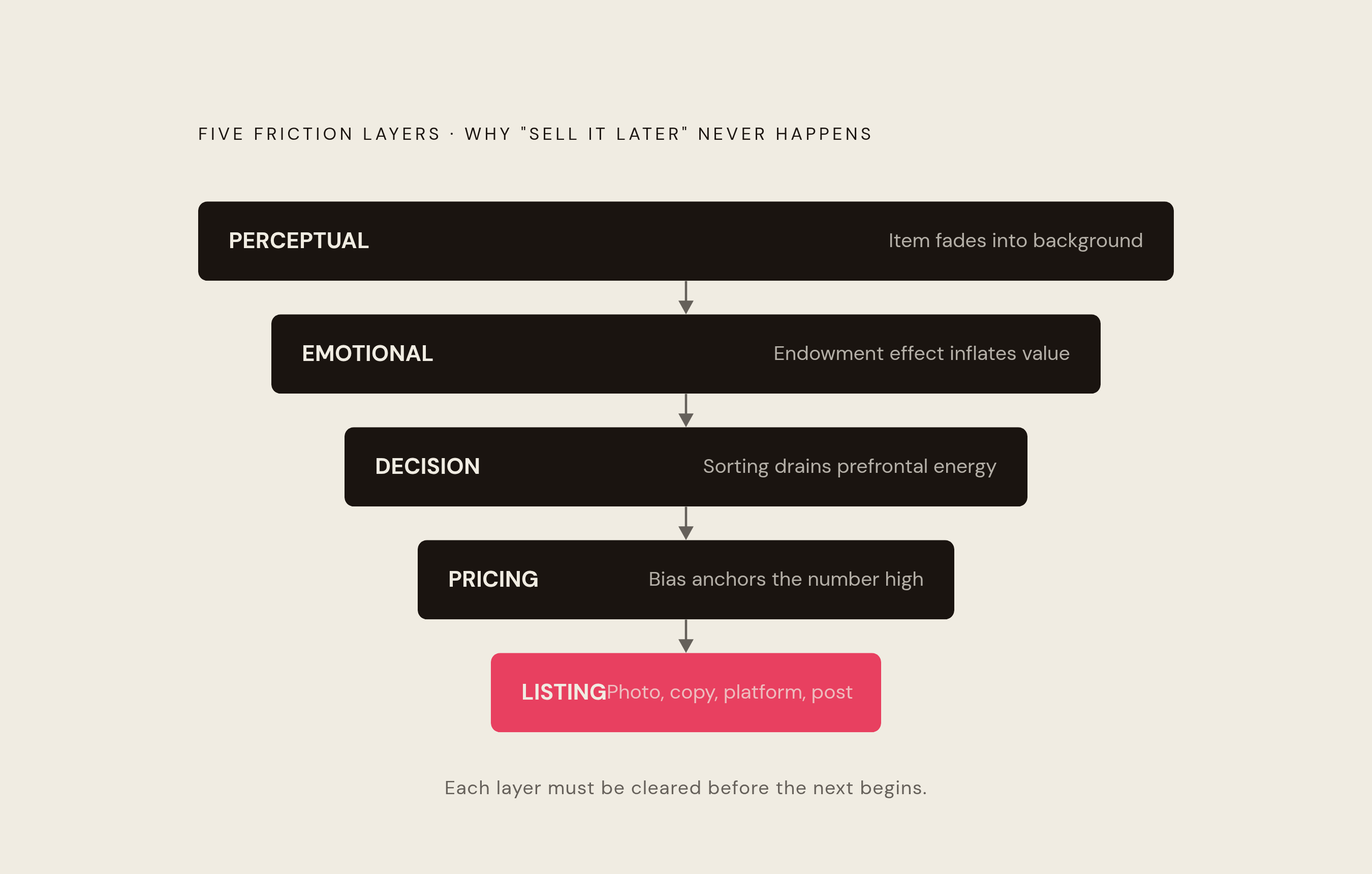
An app that only writes descriptions arrives late to the problem. The owner may still be overlooking the item, resisting its sale, or trying to establish a price. Photo-first capture, AI identification, market-data pricing, and multi-platform listing need to work as one workflow.
The photograph addresses the perceptual layer by drawing attention back to an object that had become background. AI identification then reduces the decisions needed to describe it. A workflow that proposes a condition grade and drafts the listing from a single photo can reduce the pre-listing burden, but the listing still needs accurate disclosure of defects and completeness. A photograph is not a functional test.
Immediate sold-price data addresses both emotional anchoring and research effort. It grounds expectations in completed transactions before the owner builds a case around an optimistic asking price. Automated market-data pricing also removes the need to repeat a manual search for every object. The distinction is essential. A fast price suggestion helps only if it rests on what comparable items actually sold for.
From there, cross-posting to eBay and Facebook Marketplace removes platform switching and duplicate listing work while accommodating each audience’s expectations. Shipping and payouts should remain with the marketplace so the seller retains control of their money. The app does not need to hold funds to remove work.
Finally, the workflow must shorten the distance between intention and action. Reducing the journey from noticing an item to listing it from hours to seconds turns a vague future task into a near-immediate sense of progress. It cannot guarantee a buyer, but it can get the item in front of one before the intention fades.