The Secondhand Seller's Pricing Shortcut That Goes Straight From Snap to Live Listing
Sold-price data, not asking prices, is what should set your listing price.

Photo-to-listing tools let you take a picture, review an automatically written listing, and publish to Facebook Marketplace or eBay without writing the description yourself. Tools that use actual sold prices replace asking-price guesses with evidence of what buyers paid, turning the trip from snap to live listing into a pricing shortcut as well as a time-saver.
Why asking prices are the wrong anchor for used-item pricing
A seller sees similar used phones listed online and copies the price. It feels sensible, even cautious. But those other phones are still waiting for buyers, so the seller has borrowed someone else’s wish. An asking price shows what an owner wants. A sold price shows what a buyer agreed to pay in a transaction that closed.
That gap explains why a sale expected to take days can sit for weeks. An active listing may look polished and confident without being priced realistically. Copying it gives the guess another home. The useful anchor is what comparable items have recently sold for.
Owning the item makes it surprisingly easy to miss that difference. Kahneman, Knetsch, and Thaler documented the endowment effect in the Journal of Economic Perspectives, describing a bias that can lead owners to value an object roughly twice as highly as buyers do. The buyer does not inherit your attachment. Sold data provides an outside reference before affection appoints itself head of pricing.
How to find real sold prices on eBay and what to do with them
Start by searching eBay for the exact item or a close match, then apply the sold-listings filter. The default results show active asking prices, which are the wrong starting point. If you use completed listings, distinguish actual sales from listings that ended unsold. An expired listing is not a transaction. For Facebook Marketplace, which has no sold history, eBay provides a practical outside reference for items such as used phones and couches.
Next, look at what several items like it have sold for recently. One sale at an unusually low price or a lucky high price should not set the price for everything else. The aim is a repeatable range. Matching the model and condition makes that range more useful than collecting every result with roughly the right name.
Best Offer sales need a separate check. eBay displays the original asking price crossed out rather than the accepted amount, so treat those results as price-unknown. eBay’s Product Research tool, formerly Terapeak, shows accepted-offer prices and provides a longer lookback. It is free for sellers with Seller Hub access. Without that information, a crossed-out price is not a reliable sold comp.
For thin or niche categories, widen the search terms and price toward the low end of the comparable sales available. Rarity alone does not establish demand. A sparse sales history is exactly where an ambitious asking price can become especially misleading. This manual method is teachable and useful, but searching, filtering, and reading the results takes several minutes per item.
Adjusting from the comp: condition, negotiation buffer, and fee math
Once you have a comp, adjust for condition. Like-new items with packaging retain a stronger share of retail value than good, lightly used pieces, while fair but functional items fetch less. Rough or for-parts items sit at the bottom. Most used goods sell for a fraction of their original retail price, so the old receipt is background information.
Condition also needs to be visible in the listing. Photograph and disclose flaws rather than leaving the buyer to discover them at pickup. A disclosed defect can be priced into the deal. The same defect found after someone arrives can prompt renegotiation or cancellation.
Negotiation changes the list price again. Facebook’s built-in Make an Offer feature gives buyers a way to bargain, so a modest buffer above your real minimum leaves room for the exchange. To calculate that minimum list price, add desired net proceeds, platform fees, payment processing, shipping, packaging, and the negotiation buffer. Gross proceeds are not take-home money. The costs still get their turn.
Those costs can change which price is workable. Facebook’s shipped-sale fees are generally lower than eBay’s on a typical sale, but its minimum fee can reverse the comparison for low-value items. If the item remains unsold after the first week, reduce the price, then reduce it again after another unsold week. A correct comp is only the beginning. Sellers too often skip or guess how much to allow for condition, bargaining room, and costs.
Is there an app where a picture creates the listing and sets the price?
Photo-based AI listing tools can identify an item, estimate its condition, surface sold comps, and generate its title, description, item specifics, category, and suggested price. That replaces a chain of separate tasks with one starting action. The photo starts the work. The seller still reviews the result before publishing, rather than treating the image as a substitute for judgment.
The important distinction is where the price comes from. A tool that pulls real eBay sold-listing data suggests a price based on what buyers have paid. A tool that draws from active listings may write an excellent description while reproducing the original pricing error. Fluent copy is not market evidence. “Generates a listing” and “prices from sold data” describe different capabilities, and only the second bases the price on completed sales.
The useful criteria are sold-data pricing, condition matching, editable results, and publishing to the intended marketplaces. Writing support removes typing. Combining it with transaction data also removes the need to conduct a separate pricing search before the listing can be finished.
Facebook Marketplace’s local, real-time view still has a genuine advantage. National eBay sales can lag a locally saturated category, so nearby active listings may reveal competition that older completed sales do not capture. That is a reason to calibrate the suggestion. Local asking prices can also reflect a whole neighborhood overpricing the same item.
Category-specific resale realities that change which price the data gives you
Electronics make the age of a comp especially important. Gaming consoles have consistent year-round demand, while laptops depreciate as new model releases arrive. A laptop should be sold promptly after an upgrade. Show devices turned on, and state their battery health, any cracks, and which accessories are missing. A price for a complete, working device is a poor guide to one with undisclosed problems.
Clothing requires a different reading of the results. The brand often matters more to the price than condition, and buyers who follow fashion can pay a lot for vintage band tees. OfferUp’s 2025 Recommerce Report with GlobalData puts clothing at roughly a quarter of secondhand purchases nationally. Yet buyer habits vary by platform. Facebook tends to work well for bundles, such as kids’ clothes grouped by size or season, and single pieces worth a lot, while everyday clothes sold one at a time do better on platforms built for fashion and shipped sales.
A working KitchenAid stand mixer found inexpensively can be worth substantially more on Facebook Marketplace and typically sells quickly in most urban areas. The purchase price is not the resale benchmark. Here, identification and sold comps can prevent underpricing. Use what comparable working models sell for as the resale benchmark.
WorthPoint offers historical sold prices from eBay and auction houses through a subscription with a free trial, making it useful when antiques and collectibles have too few recent comps. Category tools narrow the search further. BookScouter compares 30+ vendors for books, PriceCharting is free for categories including video games, cards, comics, coins, Funko Pops, and LEGO, and Discogs provides sales data for vinyl. These sources help a seller check whether the tool’s suggested price fits the item they have.
Matching item type to marketplace before hitting publish
The final calibration is whether the platform has the right buyers for that price. Facebook Marketplace is the stronger fit for furniture, bulky goods, and things buyers want to inspect in person. A couch that is expensive or impossible to ship affordably can still sell locally within days, with zero seller fee for an in-person transaction.
eBay works well for collectibles, electronics, and items buyers search for by specification. Its sold history also supplies the pricing baseline used beyond its own marketplace. But audience and proceeds are separate questions. For most categories, eBay charges a higher percentage selling fee plus a per-order amount than Facebook charges on a typical shipped sale. For goods that sell for little, Facebook’s minimum fee can take a higher share of the price instead.
Shipping adds another cost to the decision. Facebook Marketplace removed prepaid shipping labels for new listings on February 24, 2025, requiring sellers to provide and pay for their own labels. Prepaid labels were reinstated for select sellers around September 2025. Availability therefore cannot simply be assumed. If shipping is enabled, the list price needs to cover the label cost so it does not come as an unpleasant surprise after the sale.
Many experienced sellers use both marketplaces, start with the same sold-data benchmark, and change the negotiation buffer to fit how buyers bargain on each platform. That does not make every item equally suited to both. Publishing to both from one photo removes the duplicate listing work, leaving platform choice as a judgment call.
Putting it together: what the snap-to-listing workflow looks like start to finish
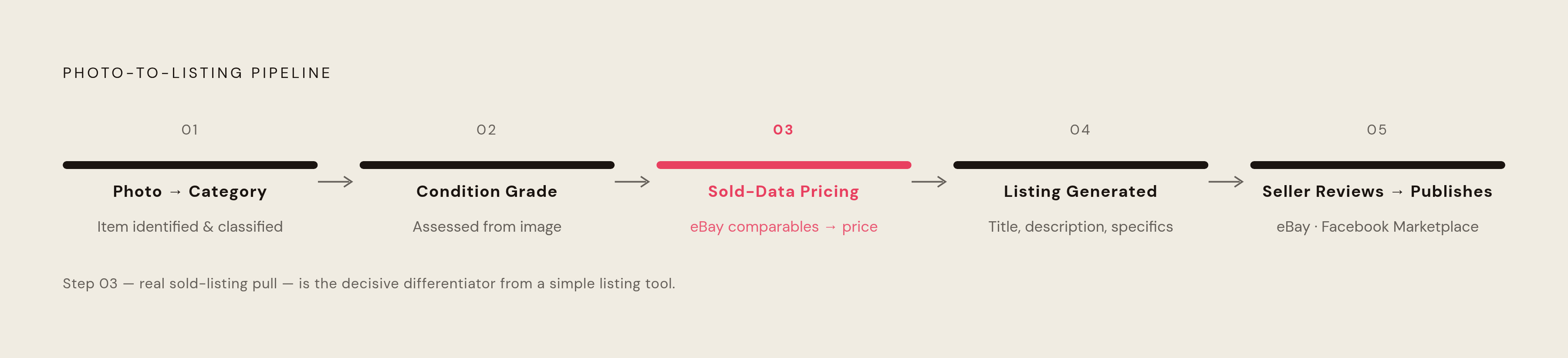
The sequence starts with one photo. The tool identifies the item, assigns a category, and proposes a condition grade from the image. It then pulls real eBay sold-listing data for comparable items in comparable condition and suggests a price from that cluster. This is the decisive step.
The tool then writes the title, description, and item specifics. The seller reviews the identification, corrects anything wrong, and decides whether the condition grade is accurate. A photo cannot settle every judgment call. Battery health, missing accessories, and other relevant details still need an honest review, and the final price remains open to adjustment for condition, costs, and negotiation.
After that review, the listing can publish to eBay, Facebook Marketplace, or both without switching between apps. Shipping and payouts stay with the marketplace, rather than requiring the seller to hand money to a third party. The seller also decides whether to allow negotiation and when to accept an offer.
The five-to-ten-minute manual comp search drops to seconds, while identification and writing happen in the same flow. That makes listing easier to finish between other demands. Speed, however, is not the strongest reason to use it. A sold-data workflow gives the price an external anchor, correcting the ownership bias that made the item seem unusually valuable in the first place.