The Moving-Day Selling Stack That Clears a House Before the Truck Arrives
Sort, screen and price your belongings so only worthwhile items get listed.

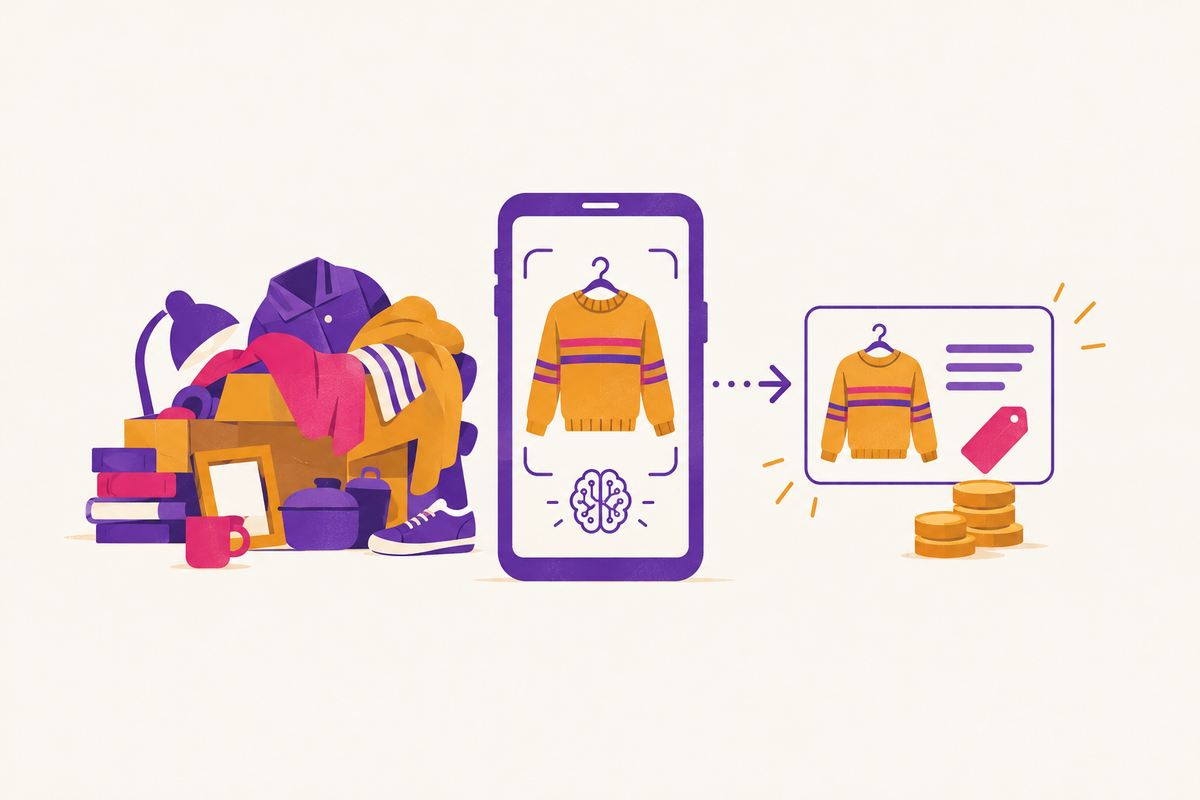
Sort first, sell only what earns the effort, price for speed, and give everything else an exit. AI-assisted listing tools can turn a photo into identification, condition grading, and copy, but the fastest whole-house clearance still depends on deciding what never needs a listing.
Why moving creates a narrow window to convert clutter into cash
Every item still in the house when the truck arrives needs to be boxed, carried, transported, and stored at the new address. That makes the old printer less of a harmless cupboard resident and more of a passenger with luggage. Selling it might recover some cash, but only if the sale earns back the effort it takes.
Time is the scarce resource in this trade. An item worth a lot deserves time spent on research, photos, and messages with buyers, but one worth little can take just as much time for almost no money. Ad hoc selling ignores that difference and lets whichever object catches your eye dictate the afternoon. A set order gives things worth selling a chance to go without letting the rest hold up the move.
The four-pile sort and why "decide later" kills the system
Before any listing work begins, assign every item to keep, sell, donate, or trash. Work through the rooms with those destinations in mind rather than stopping to write an advert whenever something looks promising. The sort comes before the sales pitch. Its purpose is to separate what travels with you from what needs an exit, so the listing work starts with a defined pile.
“Decide later” sends unresolved items back toward the keep pile, where they can quietly acquire a box and a place on the truck. That is not a decision, just a relocation. The sell pile needs discipline too, because putting an object there commits you to doing something with it before the moving deadline.
Furniture, appliances, and exercise equipment belong in the sell pile only if they go up for sale within days. A couch listed three weeks out has a chance, while the same couch listed four days before the truck arrives almost certainly gets moved. A used treadmill or elliptical deserves particular scrutiny because it is expensive to transport and resells modestly locally. Unless it is a premium piece, list it early or donate it to save the cost of moving it.
The minimum-price threshold that cuts low-ROI items from the sell pile
Use a minimum-price threshold to screen the sell pile. If an item would cost a meaningful amount to replace, consider listing it. If it would not, donate it and move on. This is a time-management rule. The threshold gives you permission to stop.
A cheap item still needs someone to photograph it, describe it, answer messages, and arrange a handoff. A no-show can add another round of the same work. The platform fee is only a small part of what the sale costs. Generic no-name electronics, CDs and DVDs outside rare boxed sets, fast fashion basics, CRT TVs, standard printers, and IKEA furniture almost never justify that effort. Something can be useful without being worth selling individually.
Bundling can change the calculation without multiplying the work. Children’s clothing, books, kitchen items, tools, or toys that fall below the threshold alone may clear it as a lot. That creates one listing, one transaction, and one handoff. Keep the bundle subject to the same test, though. Grouping low-value items helps only when the likely return justifies handling the sale.
What items actually clear the threshold and what they sell for
Pre-owned unlocked iPhones and refurbished laptops are worth listing, although storage, specifications, condition, and carrier status strongly affect the price. There is no useful blanket price for “a laptop.” Before any handoff, wipe the device completely and sign out of all accounts, including Apple ID, Google, Samsung, and Microsoft.
Patagonia fleece, including Snap-T and Retro-X, The North Face Nuptse, and Carhartt vintage chore coats are among the more profitable apparel categories. Shein, Forever 21, and H&M basics rarely sell fast enough to make it worth listing each one when time is short. The label is a filter. Condition and the exact item still determine the likely return.
For home goods, look first at useful, recognizable appliances. Instant Pots, air fryers, Dyson and Shark vacuums, and KitchenAid stand mixers consistently find buyers on Facebook Marketplace. Their weight makes local pickup more practical than shipping. By contrast, modest local resale prospects make ordinary exercise equipment a less attractive use of selling time. Bulky does not automatically mean valuable.
Vintage Pyrex, Hot Wheels, Coach bags, and vintage Levi’s have active buyer pools, with condition and completeness shaping the result. Collectors also look for Retro Nintendo cartridges, Pokémon, and Mario titles. A cheaply acquired cartridge can command multiples online. Check sold prices for these categories before deciding whether to donate them.
How to price the items you're keeping in the sell pile
Active listings show what sellers hope to get, while sold listings show what buyers actually paid. On eBay, search the exact item and switch on the Sold Items filter. This is a simple lookup. On Facebook Marketplace, look for sold or pending items rather than relying on active listings, while recognizing that pending is not yet a completed sale.
Find the median of recent sold prices for the exact item, then adjust for condition. Like-new goods with their box or tags belong toward the upper end, while lightly worn, fully working items sit nearer the middle. An item that works but shows wear belongs nearer the lower end. Rough items or those sold for parts belong at the bottom. Describe the actual tier with more detail than “pretty good” provides.
Sell-through rate is sold listings divided by total active listings for the same item over a recent period. A low rate signals that supply outstrips demand. In that case, a moving seller needs to price toward the bottom of the sold range rather than wait for the market to develop an interest in the garage.
Before setting your floor, subtract platform fees and shipping from the expected proceeds. For a moving timeline, price at or slightly below the median of recent sold comparisons to favor speed over the last bit of margin. If you have more than two weeks, start at the median and plan one price drop at the two-week mark. If time remains after a few weeks without a sale, move toward the lower quartile, then consider clearance pricing or a bundle.
Matching each item to the right marketplace before listing
Facebook Marketplace fits furniture because buyers can inspect it locally and avoid expensive shipping. Appliances follow the same route because they are heavy and impractical to post. Baby gear and kids’ toys also work well for local pickup because parents can check them before buying. These are cases where proximity is part of the offer.
Shippable specialist items benefit from a wider audience. eBay suits electronics because its item specifics help buyers find exact models, and its broader buyer pool can support prices that local buyers would underbid. Collectibles and vintage goods belong there too, with specialist buyers and an auction format available for rare items. Clothing can go to eBay, Poshmark, or Depop. For branded fashion, the chance to reach more buyers who can search by category can make it worth selling beyond the neighborhood.
Fees change the proceeds, but not always the best destination. Facebook Marketplace charges nothing for local pickup and takes a percentage on shipped orders. eBay takes a significant percentage of the total, including shipping, plus a per-order fee, with the first 250 listings per month free. A higher sale price can outweigh that difference. Buyer follow-through also counts because eBay buyers complete purchases at a far higher rate than Marketplace browsers, an important distinction when there is no time for another no-show.
For a household clearance, start with local pickup for large and heavy items. Items that can be shipped can go on eBay if no local buyer turns up, while niche collectibles should go in front of those specialist buyers from the start. Cross-listing reaches more buyers without making you do the listing work all over again. Swappa is another option for electronics, and OfferUp is an alternative for bulky local goods. The useful comparison is category fit, shipping cost, fees, and follow-through.
What's the fastest way to list a spare bedroom's worth of stuff?
Reduce the friction per item. Once the sort, pricing, and marketplace decisions are made, the remaining work is photographs and clear information. That is a manageable production task. AI-assisted listing tools can handle identification, condition grading, and copy from a photo, which helps first-time sellers who do not know the search terms or category conventions. The supported shortcut is photo-based assistance with individual listings.
Good photographs protect the price as well as the schedule. Shoot in daylight against a tidy background, then photograph flaws up close. The same item shown clearly can command a meaningfully higher price than one photographed in a dim, cluttered garage. Buyers should not have to dig like archaeologists to find the stand mixer. Showing damage before purchase also reduces the chance of a refund request or a renegotiation at pickup.
Write titles around the words a buyer would search. Include the brand, model, size, condition, and any notable feature. Save the poetry for the goodbye card. In the description, make “minor wear” specific with a measurement and a photograph, such as “quarter-inch chip on the inside rim, pictured. Being clear about flaws draws buyers who are already happy with that trade-off and helps cut down on no-shows and returns.
AI assistance is useful because it tackles that repetitive writing work. It does not remove the need for clear photographs, an honest account of condition, or a price grounded in completed sales. With those decisions already made, listing a stack of items becomes less daunting than facing a room full of separate research projects.
Routing the remainder — donation, junk removal, and the sell-by deadline
Set the hard sell-by deadline at one week before moving day. Anything still unsold then goes to donation or junk removal, and the listings stop. The clock wins this round, and gets the final say. A donation trip can clear multiple boxes and generate a receipt, although a tax deduction requires itemizing and documenting fair market values yourself. For qualifying donors, that may partially offset a lost sale.
CRT TVs, printers, broken electronics, and unusable furniture often cannot be donated, so arrange junk removal in advance to avoid a last-minute scramble. Mixed kitchen items or children’s clothing can also leave as a free curbside lot on Marketplace, potentially within hours and without a paid transaction.