Old Clothes and Forgotten Junk Sell Themselves When AI Reads the Photo First
Photo-first AI tools draft listings and price them from real sales.
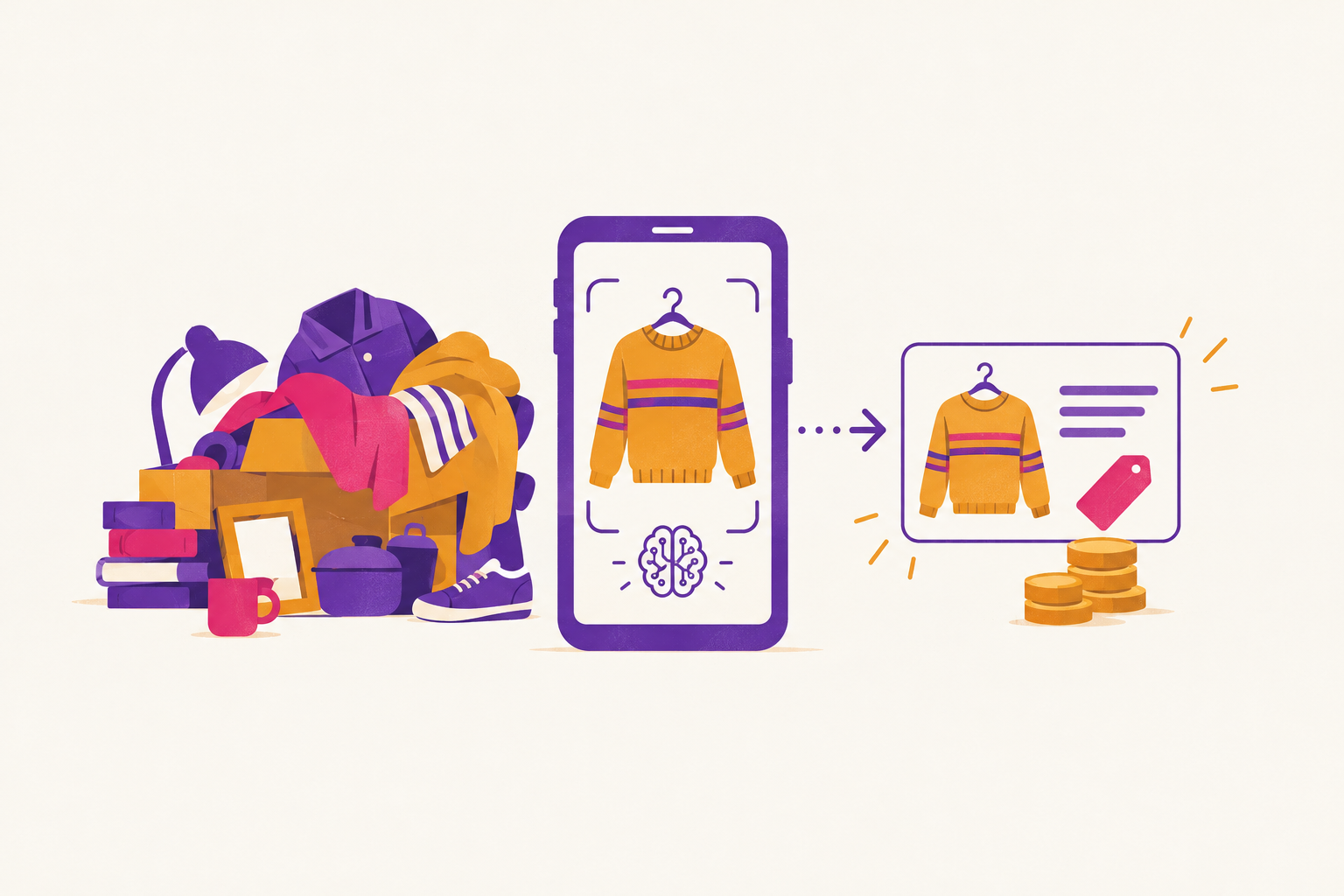
Photo-first AI listing tools turn a picture of an old jacket or forgotten gadget into a title, description, item details, and suggested price, with little or no typing. eBay’s built-in tool, another photo-first listing tool, FlowLister, and Nifty cover different parts of that process. Selling becomes doable when working out what an item is, describing it, and setting a price no longer eats the evening.
Why most people never sell the stuff they intend to sell
The jacket is ready to go. The listing isn’t. Before a casual seller can collect any money, they have to work out what the item is, write something buyers can find in search, and choose a price that isn’t a guess. Each task is small enough to sound harmless and tedious enough to postpone. Together, they turn clearing out a spare room into an admin shift with no pay.
That friction also explains the “post and pray” approach. Sellers skip the research, pick a number, and either underprice the item or leave it sitting unsold. When it goes badly, sellers have one more reason not to bother next time. Someone who wants money for a jacket may still balk at a second job filling out item specifics.
What vision-language models can now read from a single photo
Vision-language models can connect what appears in a picture with the words needed to describe it. They can read brand tags, model numbers, size labels, and maker’s marks, then use those clues to identify an item and place it in a category. The listing can also use signs of wear, missing parts, and the original packaging. No barcode is required for this recognition step.
A tagged jacket makes the change concrete. When its label is readable, the model can extract the brand and size. It can then turn that information and visible condition cues into marketplace-ready text. These tools became ready for everyday sellers quickly as general-purpose vision models got good enough at reading secondhand goods.
The camera still has a limited jurisdiction. It cannot expose a hidden stain or diagnose an internal electronics fault, and an unlabeled vintage item may reveal little about its maker. People still need to judge what the photo leaves unknown, and another well-written paragraph cannot do that for them.
The difference between asking prices and what items actually sold for — and why it matters for casual sellers
Correct identification does not automatically produce a useful price. A listing that is still up shows what someone hopes to get, while a confirmed sale shows what a buyer actually paid. For secondhand goods, the gap can be wide. A hopeful asking price is not a valuation just because somebody put it on the internet.
eBay’s “Sold” or “Completed” filters provide a free way to research past transactions, with confirmed sold listings supplying the evidence of payment. But manual research assumes the seller already knows what to search for. If the jacket’s brand or the gadget’s model remains a mystery, the search box merely relocates the work.
Purpose-built tools can close both gaps by identifying the item from its photo and pricing it against real sold listings that the seller can open. That combination is the useful distinction.
Is there an app where a photo becomes a live listing?
The workflow starts with a phone photo. The model reads the tag, label, shape, and signs of condition that it can see. In a workflow that includes sold-comparable pricing, the output brings together the item’s identity, a suggested title, a description, item specifics, a category, and a price range.
The seller reads the prepared listing. They confirm the details, accept or adjust the price, choose the photos, and decide between shipping and local pickup. Once reviewed, the listing can be published without composing a description or separately researching the item from nothing. The exact handoff depends on the tool and marketplace, and some fields may still need attention.
The software handles the repetitive preparation, while the seller keeps the decisions that require knowledge of the actual object. A later check of sold comparables is a smaller task than starting the entire process manually.
The tools that do this today and what each one actually covers
The useful comparison is between drafting coverage, price evidence, and marketplace fit. A tool that writes a description is not necessarily doing the same job as one that supplies recent sold comparables. And paying for a subscription may not be worth it for someone selling just a few things.
eBay’s AI listing tool is free and native to the marketplace. It generates a title, description, category, item specifics, and a suggested price from a photo, making it a straightforward fit for someone already planning to sell there. Its stated availability as of November 11, 2026 covers Australia, France, Germany, Italy, the U.K., and the U.S. Review remains part of the process. Sellers may need to adjust or complete fields before publishing.
Snap2List also targets eBay, generating titles, descriptions, categories, item specifics, and pricing suggestions from product photos. Its free tier lets sellers list a limited number of items each month, so those who sell only now and then can start without paying, while paid monthly plans are also available. FlowLister is aimed at eBay-first sellers listing varied one-off items, especially part-time thrift, garage sale, and estate sale sellers. Chris Taylor, a full-time eBay reseller, founded it in 2025. Its Starter plan costs $19.99/month to list up to a set number of items each month.
Nifty, formerly Auto Posher, generates titles, descriptions, categories, and item specifics from up to 8 photos. It suggests a price when it can find recent comparable sales, so sellers should not expect every item to get an estimate backed by sales. Monthly paid plans are available. For specialist price research rather than the general photo-to-listing workflow, PriceCharting covers categories including games, cards, and comics. WorthPoint focuses on antiques and collectibles, while Underpriced AI publishes weekly comparisons of its estimates against actual sale results, including misses.
Which marketplace to list on, matched to what you're selling
The item should choose the marketplace. Facebook Marketplace works well for furniture, large home goods, and baby or kids’ gear because local buyers can check the item and pick it up without shipping. Common everyday items with strong local demand can move as fast or faster there. Local pickup transactions have no fee.
eBay is a stronger fit for niche and collectible items whose buyers are searching for something specific. Its national buyer pool can support a meaningfully higher sale price for those goods. eBay charges a percentage-based final value fee plus a small per-order charge. Facebook Marketplace takes a lower percentage on shipped orders but has a minimum fee.
Lowball offers, ghosting, no-shows, and scam bots can accompany new listings, and listings sometimes reach people well outside the specified area. Facebook Marketplace also offers no seller protection. For sellers choosing that route, the practical response is to leave room for haggling and meet buyers in public, rather than assuming a nearby buyer makes every part of the transaction simpler.
What items in a typical household actually sell for
Resale value varies sharply by category, brand, and condition. A broad label such as “used clothing” says little about the likely return, because a recognizable brand can change the price substantially. That variation is precisely why an item-level sold comparison is more useful than a blanket estimate for everything in the wardrobe.
Underpriced identifies used PS5 consoles, Herman Miller Aeron chairs, and Patagonia Synchilla Snap-T fleeces as examples that fetch worthwhile sums on the resale market. The condition inside a console, the wear on a chair, and the condition of a fleece still help decide which sold items are close enough to compare.
Clothing makes the identification benefit especially clear. Much of its resale value sits in the label, so a jacket from the right brand can sell for many times what an unbranded equivalent fetches. The forgotten tag may be more useful than the seller’s memory of what they paid. Reading it first helps the seller work out whether the item is worth the time it takes to write a listing.
Writing a listing that converts once the AI has done the drafting
A useful description names the item, states its condition, explains what is included, and discloses every flaw, however small. The price should reflect those flaws. Clear photos then give the buyer a way to check the description.
“Used black desk, wide enough for a full workstation setup, with a small scratch on the left corner shown in photo four” gives a buyer something to assess. “Great desk, must go” mainly explains the seller’s feelings. Measurements are equally important for clothing, furniture, and anything with inconsistent sizing, even when the generated draft omits them.
Timing and price complete that refinement. The practical approach is to list seasonal goods ahead of demand, such as winter coats in early fall and exercise equipment in January. Checking eBay’s “Sold” filter establishes what buyers paid, while pricing slightly above the average sold price leaves negotiating room without undervaluing the item.
Scams that target new sellers and how to avoid them
New sellers do not need a collection of bad experiences to recognize common scams. An overpayment followed by a request to refund the excess amount is fraud. The original payment will be reversed, leaving the seller without both the item and the refunded money. The extra payment is the bait.
Requests to pay outside the selling platform are another warning sign. They bypass whatever seller protections the platform provides, so the safe approach for shipped sales is to use its built-in payment system and wait until payment clears before shipping. Wire transfers, money orders, and cryptocurrency should not be accepted for resale transactions. For local pickup, meet in a public place, such as a police station safe exchange zone, and take only cash or instant digital payment.
Privacy starts before the buyer makes contact. Keep a home address out of the listing and messages, and remove visible mail, prescription labels, family photos, and other revealing household details from listing photos. Connected devices need separate attention. Before handing over a phone, tablet, or smart speaker, follow the manufacturer’s instructions to remove the account and wipe personal data.
Where AI pricing still needs a human check — and when that changes the number most
Photo-first AI works well on branded goods whose labels can be seen, mass-produced items that have sold often, and things whose condition shows in the photo. That covers much of the ordinary household backlog. The exceptions are identifiable, however, because their value depends on evidence outside the picture.
For an unlabeled vintage item, the seller may need to find out its maker or provenance before setting a price that makes sense. Electronics can look identical while one has a battery at 40% health or a cracked logic board. Authenticity may also require physical inspection. A convincing description cannot fill those gaps, and a suggested number should not conceal them.
The practical rule is to use AI for identification, drafting, and baseline pricing, then open two or three comparable sold listings before publishing. That check takes under two minutes and helps catch cases where the model’s confidence is lower. When condition affects the price, the seller also needs to use what they know about faults and missing parts to compare the goods.