Status Signaling in Secondhand Shopping
How showing off your thrift finds became cooler than buying new.
Secondhand shopping used to be something you didn't mention at brunch. Now it's the thing you bring up first. That flip, from private compromise to public flex, has reshaped a market worth hundreds of billions of dollars, and it's worth understanding how it happened and what it means for anyone with a closet full of stuff to sell.
The scale of the market that followed the status shift
Ninety-three percent of consumers bought something secondhand in the past year. Not "considered it." Bought it. That number is close enough to universal that "do you thrift" is basically a rhetorical question at this point, like asking someone if they've ever used a search engine.
The dollars back up the vibe shift. The global secondhand market has reached $393 billion, and in a leading market by dollar volume resale alone is projected to hit $74 billion by 2029, growing five times faster than traditional retail. Business of Fashion and McKinsey's State of Fashion 2026 report puts secondhand sales growing two to three times faster than firsthand purchases over the next two years, on track to reach $317 billion. And 88% of resale spending in that same leading market in 2024 happened online, which tells you something specific: this isn't just a shift toward used goods, it's a shift toward digital platforms built to sell them. The garage sale didn't get bigger. It got an app.
How Gen Z turned resale into a purchasing philosophy
For a lot of Gen Z shoppers, secondhand is the opening move. It's the opening move. Sixty-four percent search resale before they even look at new. Eighty-two percent check the resale value of something before they buy it new in the first place, which means they're shopping the way a day trader reads a stock: what this is worth later, not just now.
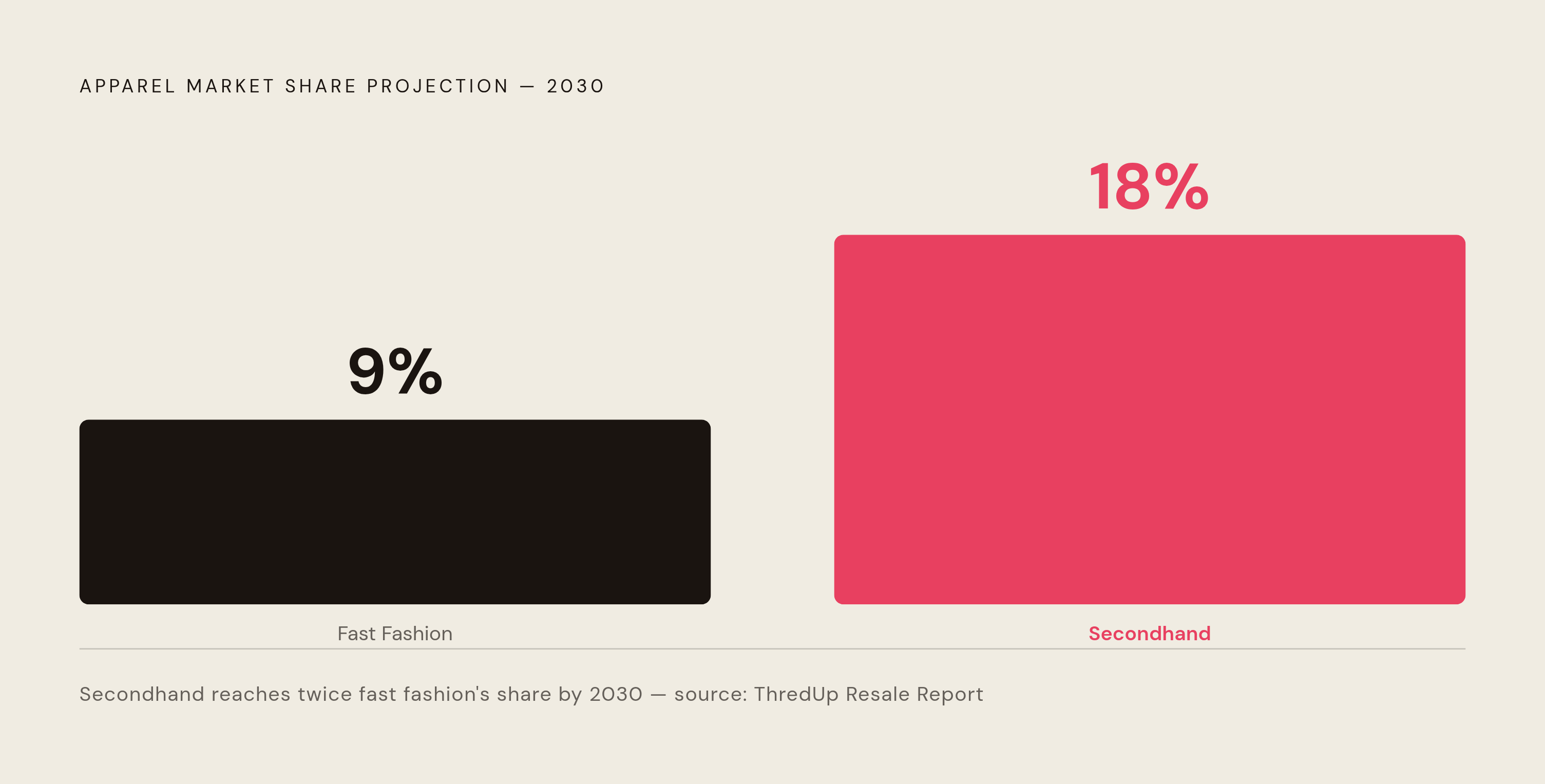
That's a genuinely different relationship with stuff. Clothes stop being pure consumption and start acting like assets with an exit strategy attached. It also explains why 49% of consumers say they're cutting back on low-quality apparel specifically because it has no resale value. Cheap fabric that falls apart after three washes is a bad investment. Fast fashion's market share is projected to stay flat at 9% through 2030, while secondhand is expected to climb to 18%, twice the size. The math on "buy it cheap, wear it twice, toss it" is starting to look worse than the math on "buy it used, wear it out, sell it again."
Curation and the thrill of the hunt as social currency
Status signals only work if they're hard to fake. Anyone with a credit card can buy a new handbag off a shelf. Finding the right vintage Carhartt jacket in the right wash, in the right size, for the right price, takes actual time and an actual eye. That effort is the point. It's a flex you can't shortcut, which is what makes it worth something socially.
Sixty-one percent of consumers say they'd keep buying and selling secondhand even if money weren't a factor. The reason people give, over and over, is the thrill of the hunt itself: the search is half the fun, maybe more than half. Younger shoppers in particular put real value on finding something unique or past-season, and that scarcity isn't a side effect of resale, it's the whole engine. Retail sells you the same shirt as everyone else in your size. Resale sells you the one nobody else can get, because nobody else can get it. That's a structural difference, not a marketing angle, and it's why a good thrift find reads less like a purchase and more like a small trophy.
How brands responded when resale became aspirational
Brands noticed. Brand-led resale programs in that same leading market grew roughly 300% between 2021 and 2025, a number that gets a mid-market brand's attention fast. Resale stopped looking like a threat to new sales and started looking like a channel worth owning.
Secondhand pieces show up on Fashion Week runways in Milan, New York, and Paris. eBay's Endless Runway put secondhand pieces from Moschino, LUAR, and Niccolò Pasqualetti on Fashion Week runways in Milan, New York, and Paris, which is about as far from the bargain bin as resale can travel. H&M opened its second Pre-Loved shop-in-shop in Beverly Hills in November 2025. Arc'teryx, New Balance, Dr. Martens, and Lululemon all had what Tersus Solutions CEO Peter Whitcomb called "banner years" in resale, with more investment planned into 2026. The North Face's Renewed program moved 96,000 items last year, which sounds like a lot until you remember it's a sliver of what the brand actually produces.
Resale-as-a-Service companies like Tersus Solutions and Trove do the unglamorous back-end work, authentication, cleaning, logistics, so brands don't have to build that infrastructure from scratch. Even so, only 147 brands had a secondhand storefront as of September. Adoption has reached only 147 brands with a secondhand storefront as of September, still a small club relative to the size of the industry.
The behavior behind status and budget working together
Sixty-nine percent of shoppers turned to secondhand when the economy felt shaky, and 79% buy used goods specifically to save money or offset rising costs. That's not a footnote, that's a real driver, and pretending otherwise would be dishonest. Bank of America Institute data shows people buying secondhand fashion more often while spending less per transaction, which is what budget stretching looks like in the data.
Tariffs are adding fuel here too. A significant share of consumers say they'll lean harder into secondhand if tariffs push apparel prices up, and Depop saw app downloads jump 110% in the first quarter of 2025 as tariff talk heated up. The same person can thrift because rent went up and thrift because it makes them look sharp. Those two motives used to feel like opposites. Now they're the same purchase.
The status shift's impact on people selling secondhand today
Selling is catching up to buying in normalcy. Bank of America Institute reported the number of customers selling secondhand clothing grew 16% year-over-year in March, and Gen Z made up 41% of sellers year-to-date in 2026. Listing your old stuff isn't a garage sale anymore, it's practically a hobby.
Online resale accounts for 88% of resale spending, so a seller sticking to in-person only is skipping the room where the money actually is. And because secondhand carries real social weight now, buyers pay more for listings that look put together: clean photos, honest descriptions, a little curation on the sell side too. The same uniqueness that makes resale feel special also makes it a pain to price. There's rarely a twin listing to compare against. Sellers need actual sold data, not just what other people are hoping to get.
Matching the item to the platform where its status is understood
Picking a platform is about whether the right buyer is even looking there. It's about whether the right buyer is even looking there. A $100 item can sit forever on the wrong site because the audience that wants it is browsing somewhere else.
Sneakers and athletic shoes (Nike, Hoka, On Cloud) do well on eBay, which offers authentication on sneakers over $150 and remains one of the strongest resale categories going into 2026. Vintage and Y2K apparel, along with streetwear, fits Depop's audience and its recently dropped seller commission for sellers in that leading market, making it one of the cheapest places to sell in 2026. Men's workwear like Carhartt and Filson, plus vintage Americana with collector appeal, tends to find deeper buyer pools on eBay. Luxury handbags from Louis Vuitton, Gucci, and Chanel stay strong resale categories where authentication and buyer trust carry real weight, another spot where eBay's authentication programs verify seller claims and give buyers confidence.
Trading cards, Funko Pops, vinyl, and other collectibles do well on Whatnot, or on eBay for its collector community and authentication tools. Furniture, large appliances, and anything needing local pickup belongs on Facebook Marketplace, which has over 1.1 billion monthly users, no listing fee, and no platform fee on local pickup sales. Small appliances and kitchenware split the difference: Facebook Marketplace for volume, eBay when the item has collector value, think vintage Pyrex, Le Creuset, or KitchenAid. Consumer electronics, video games, and replacement parts do best on eBay, where the depth of buyers for vintage tech isn't matched elsewhere.
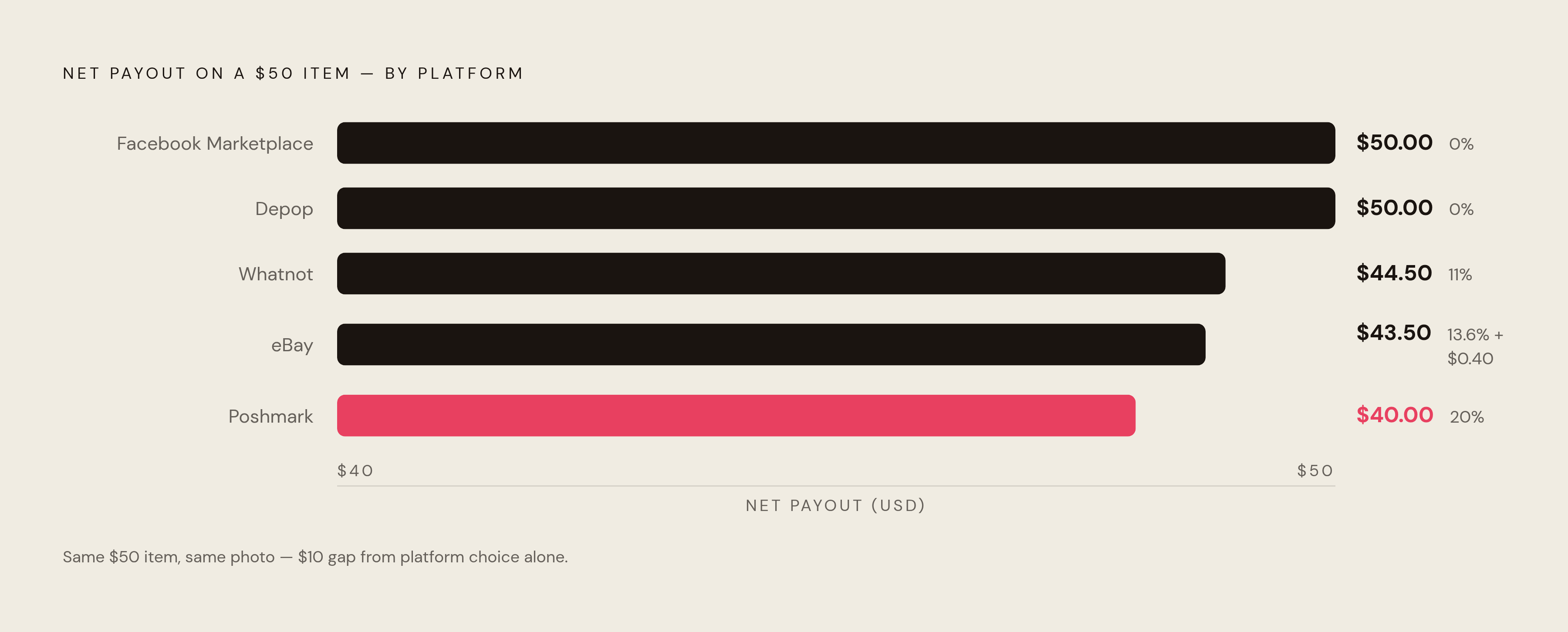
Fees matter too, and they add up fast across a lot of listings. As of 2026: eBay charges 13.6% plus $0.40 per sale. Poshmark takes a flat $2.95 under $15, or 20% at $15 and up. Depop charges 0% seller commission for sellers in that leading market. Whatnot runs around 11% in total fees. Facebook Marketplace charges nothing for local pickup, and 10% (with an $0.80 minimum) on shipped orders. Run a $50 jacket through the math: it nets around $40 on Poshmark, but the full $50 on Facebook local. Same jacket, same photo, ten-dollar difference just from picking the platform.
Pricing secondhand items the way buyers shop
Buyers got smarter right alongside the status shift. Anyone hunting for collectibles, sneakers, or branded goods now checks sold comps before paying, the same way someone might check a used car's history before signing anything.
Active listings aren't market prices, they're wish lists. Pricing off what other sellers are asking means pricing off hope, not reality. eBay's Sold Items filter (Filter → Show More → Sold Items toggle in the app) shows the last 90 days of actual completed sales, and sorting by "Ended Recently" gets close to a live read on current value. For deeper digging, the Product Research tool in eBay Seller Hub (formerly Terapeak) pulls up to three years of sales history, including the actual Best Offer prices buyers paid, while standard search still shows the inflated asking price. A listing showing an asking price in search might have actually sold for a fair amount less after a Best Offer got accepted, so a seller pricing off the visible number alone is working from a number nobody actually paid.