Turn a Garage Full of Stuff Into a Full Batch of Live Listings Before Lunch
A three-phase workflow of photos, sold-data prices, then listings.

Turning a garage full of stuff into live listings before lunch takes a batch workflow. Photograph everything first, price it from sold data, then write all the listings before publishing. eBay’s AI listing assistant can draft titles, descriptions, and categories from photos, while a general-purpose AI chatbot suits sellers who want a fixed writing template. Neither capability establishes that one whole-room photograph can generate every listing.
Why a garage session stalls out before it starts
The morning unravels when every item becomes its own project. You photograph a drill, look up its price, write a description, publish it, then pick up a console and start again. Each time you start again, you have to shift your attention. The garage is now an office with terrible heating.
Pricing is where that routine usually bogs down. It takes focus to find sales of similar items, weed out outliers, and pick a price, especially when the next item is in a completely different category. Meanwhile, the camera waits and the listings remain unwritten. A production line fixes that by keeping similar decisions together.
The three phases that separate a fast session from a slow one
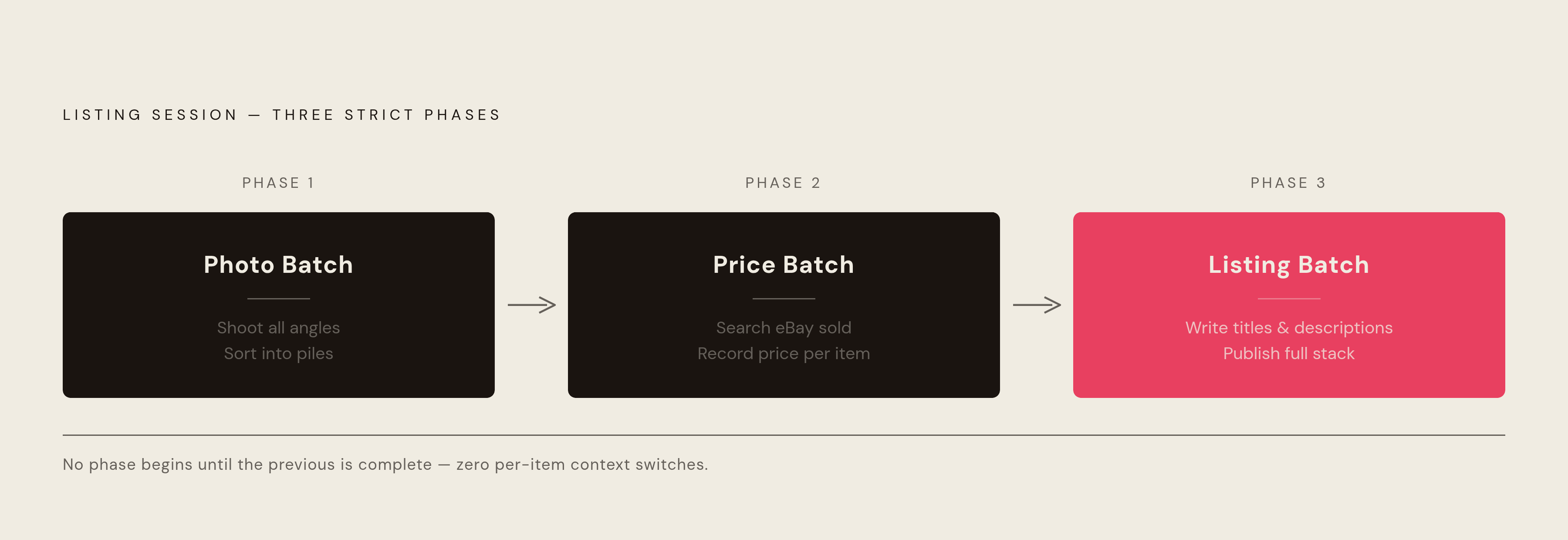
The session has three distinct phases, which are photos, prices, and listings. During the photo batch, walk through the items and capture everything needed for research and copy. This is the moving-around phase. During the price batch, sit down with those photos and work through sold comparisons in one pass.
The listing batch comes last, once the evidence and decisions are ready. Write or generate the titles and descriptions in sequence, fill the structured fields, and then publish the stack. Research and writing stay separate, just as photography stays separate from research. Combining them may feel like finishing things faster, but it restores the context switches that consume the morning.
How to run the photo batch efficiently
To put that structure into practice, clear a consistent shooting surface before taking the first photo. A plain wall or neutral cloth near a window gives the batch a simple backdrop and natural daylight. Keep the setup the same throughout the session. This is documentation.
Aim for at least five photos per item, covering the front, back, branding or model markings, and any flaws. Make damage unmistakable in its close-up. Photograph labels instead of transcribing them, because those images support later pricing searches and AI-assisted drafts. More useful angles also mean fewer questions and fewer buyers backing out after an inspection.
As you take photos, put items into three piles for eBay, Facebook Marketplace, and donation or bundling. Use provisional routing and leave research for later. Goods that can be shipped and need a national buyer go toward eBay, while bulky goods go toward Marketplace. Generic household pieces belong in bundles or the donation pile. Old iPhones, MacBooks, and gaming consoles need a price check before they get written off as drawer fossils.
What actually determines what a used item is worth
An asking price records what a seller wants. A sold price records a completed transaction. That distinction changes the entire pricing exercise. Copying prices from active listings can get someone else’s wishful thinking impressively right.
The item’s condition then decides which sales are a fair match. As a rough framework, like-new goods with packaging may retain a strong majority of retail value, while good, lightly worn, fully functional items may sit around 30–50% of retail. The price drops when wear shows, and rough or parts-only goods need clearance prices. A branded power tool, working Apple Silicon MacBook, or sought-after retro console can depart from the standard percentage because demand changes the comparison.
Ownership adds another distortion to the calculation. Economists Daniel Kahneman, Jack Knetsch, and Richard Thaler documented the endowment effect, which makes owners value their possessions more than strangers do. A buyer is not purchasing your fond memories. Sold-comp research corrects that bias mechanically by replacing the number in your head with evidence from actual transactions.
How to run the price batch without researching each item from scratch
With the photos open, repeat the same research loop for each item. Search eBay using the brand, model, and relevant condition, then switch from the default active listings to sold listings. Completed listings are useful only when the item actually sold. Read the last five to ten sold prices and look for the middle cluster. Record a price decision before moving on.
Keep specialist tools available for categories in the stack. BookScouter compares what vendors offer for books, while PriceCharting covers video games and trading cards and has a free app. Discogs has free data on real sales of vinyl records, and a paid subscription to a research service gives access to research on antiques and collectibles. Identification comes before valuation for mystery objects. Google Lens is a free option for that first step.
Facebook Marketplace does not show sold-price history, so start by comparing sales on eBay. Allow room above your real minimum for negotiation through Make an Offer. Then calculate the required list price from desired net proceeds, platform and processing fees, shipping, packaging, and a negotiation buffer. eBay charges approximately 13.25% plus a small per-transaction fee, while Marketplace local pickup is free and shipped orders have a percentage fee with a minimum charge.
Which items belong on eBay and which belong on Facebook Marketplace
With prices recorded, resolve the provisional piles using three questions. Does the item need a national buyer to sell for its market value? Would shipping meaningfully reduce profit or increase damage risk? Is the likely sale price high enough to justify eBay’s additional fees in exchange for its larger audience?
Furniture, appliances, exercise equipment, and other heavy goods are usually a good fit for Marketplace local pickup. Shipping is the obstacle those listings avoid. Collectibles, branded clothing, electronics, and gaming gear usually suit eBay’s national audience, sold-price history, and structured item specifics. On Marketplace, clothing works better as bundles or higher-value designer and vintage pieces than as individual everyday garments.
A Marketplace price modestly above the eBay equivalent can be defensible because the buyer avoids shipping and faces local-only competition. The seller also avoids a platform fee on local pickup, leaving room to negotiate. Those differences are a reason to distinguish the item’s market value from the total cost and convenience of the transaction.
Writing titles and descriptions fast without sacrificing conversion
To begin the writing batch, use the same title structure for every eBay draft. Combine brand, model or pattern, key specifics, descriptive modifiers, and year or era when relevant. Use the 80 characters for terms that help buyers find the item in search.
Open the description with the item, its condition, and its most relevant features. Most eBay shoppers browse on mobile and see only the first couple of hundred characters before a “Read more” link. Say exactly what cosmetic wear there is and where it shows. For Marketplace, keep the copy shorter and lead with condition and pickup logistics.
Choose writing tools by the job they perform. eBay’s own AI listing assistant generates titles, descriptions, and category suggestions from photos, making it a starting point for common shoes, electronics, and clothing. Vintage or unusual objects need more refinement. ChatGPT suits sellers who want control over a fixed template, provided the prompt is set once and reused.
After the titles and descriptions, fill eBay’s Item Specifics in a separate pass. Those structured fields help listings surface in search, so polished prose does not replace them. Check the drafts before they go live, especially the AI-generated details. Then publish the stack in one pass. Keeping the mechanical publishing work out of drafting protects the writing rhythm.
Category decisions that determine whether an item is worth the time
The donate-or-bundle pile needs a clear rule before it quietly turns into another afternoon’s work. Apply this triage during the initial walk-through and again while photographing. Recent iPhones, Apple Silicon MacBooks, and gaming consoles deserve individual attention. Show electronics powered on and disclose battery health, cracks, and missing accessories, with controllers and games bundled where appropriate.
DeWalt, Milwaukee, and Makita cordless tools retain a substantial share of retail value, while Bosch professional-grade tools also hold value, though somewhat below those three. Compatible batteries can strengthen buyer interest. For games, check PriceCharting before dismissing N64 or GameCube titles, select PS1 RPGs, rare RPGs, or sealed modern titles. Vintage turntables, stereos, and speakers also deserve research before receiving garage-sale prices.
Generic lamps, throw pillows, utensils, and decorative pieces rarely justify separate listings, so bundle them by theme or lot. Children’s clothing fits size-grouped Marketplace lots. Books and media usually sell for little, though rare first editions, vintage vinyl, and sealed video games need a price check. BookScouter can help screen books before they leave the batch.
For goods headed to a garage sale, use round clearance prices and a sticker on everything. Cut prices in the final hour to avoid re-boxing. Space recovery is part of the return. A negligible sale after a long listing session is not a victory simply because money changed hands.
Scam patterns that slow or kill a live listing session
Once listings go live, three patterns deserve immediate suspicion. A buyer may push to move the transaction off-platform, present a fake payment screenshot, or claim an overpayment and request a refund. Each can turn a finished batch into hours of trouble. A forwarded email is not proof of payment.
Keep transactions on-platform and verify payment inside the marketplace. Never ship before payment clears in the system it came through. Facebook’s safety guidance says to use Facebook Pay or in-app checkout for shipped orders instead of cash apps, wire transfers, or gift cards, which have no purchase protection. For in-person deals, meet publicly and bring someone if possible. A buyer’s refusal to meet publicly is a reason to stop.
What the session looks like from start to live listings
The night before, or during the first few minutes, gather the phone or camera, plain backdrop, and tape and boxes for anything being shipped. Walk the garage once to identify bundles, donations, and likely platform destinations. Then begin the photo pass without opening a pricing search. The drill gets its angles and model label, the console gets its powered-on shot, and the bulky exercise equipment joins the local-pickup pile.
Once the last item is photographed, sit down with the photos open on one screen and eBay sold listings on another. Work through the stack, using the category tools only where they fit. Each item receives a recorded price before the next begins. The first guesses about the eBay and Marketplace piles are now firm choices about where each item goes.
Next, use the photos and prices to write drafts with the chosen tool or fixed template. Complete titles and descriptions, fill Item Specifics in bulk, review the stack, and publish in one pass. For a typical garage session, those three sequential phases make a pre-noon finish realistic, though they do not promise a sale before lunch.