Estate Sale Reselling as a Sourcing Subculture

Estate sale reselling is a sourcing subculture built around a simple advantage, namely knowing what a household’s contents are worth when the seller’s priority is clearing the house. Capturing that value takes more than spotting old things. The buyers who profit understand the people, the rules, the inventory and the numbers before a promising find becomes an expensive way to spend Saturday.
Why estate sales produce arbitrage that thrift stores structurally cannot
Thrift stores sort donations before putting them out, have staff who know the basics of resale price them, and have resellers pick through the stock when they open each day. That process compresses the gap between the shop price and the resale price before another buyer arrives. An estate sale starts with a different problem. A household’s accumulated possessions must leave the house in two or three days, and the liquidation company prioritizes clearing them over maximizing every item’s value.
That deadline leaves room for specialist knowledge to beat generalist pricing. A family or liquidation company may not know what Hull pottery or a vintage Starter jacket fetches on the secondary market. Tariffs have widened the gap further, with new equivalents costing 20–40% more while estate inventory was manufactured and imported before the current tariff environment. Chairish has started promoting that effectively tariff-free framing to buyers. Serious buyers have developed a methodical subculture around this opportunity, and knowing that subculture determines who captures the value.
How the estate sale subculture is organized — the hierarchy of participants
At the top of the informal hierarchy are specialist dealers and collectors who arrive before opening and know exactly which categories they want. For them, the opening window is the part of the sale that matters. Next come experienced resellers, who have studied the photos and picked which objects to look for first.
Weekend browsers arrive mid-morning and usually vie for what those first groups left behind. Last-day bargain hunters form a group of their own because they choose to have less to pick from in exchange for lower prices and deals on bundles. A specialist after one collectible and a reseller looking for a cheap bundle want different things from the same house.
The numbering system makes this hierarchy visible at the front door. Popular sales distribute numbers an hour or more before opening and admit buyers in groups, so arriving at opening can mean being number sixty. Inside, liquidation company staff control another important part of access because they price untagged items on the spot. Experienced buyers ask politely on day one and accept the answer without negotiating. Understanding both the queue and the staff’s role is an entry cost.
The unwritten rules that govern behavior at a sale
Respecting the number system protects a buyer’s standing with staff and regulars. Trying to skip the queue is a quick way to become memorable for the wrong reason. The same principle governs day-one pricing, when prices are firm and staff are managing a crowd. Experienced buyers accept the price or move on rather than turning an opening rush into a private bargaining session. Aggressive negotiation signals inexperience and spends goodwill that may matter at another sale.
Other rules are less social but just as capable of stopping a purchase. Most companies take cards, but some remain cash-only or charge a card fee, and the listing states the terms. Bag policies also vary, with some companies requiring bags to be checked at the door. A large tote is not much of a sourcing advantage if it cannot enter the house.
Checkout creates a quieter problem because buyers leave with one receipt and one total. Resellers still need to know what each item cost, so experienced buyers remember prices or take photos of tags before they pay. Negotiation belongs at the other end of the sale, when staff want the remaining contents gone and welcome bundle deals. Following these norms builds a reputation as a reliable, easy buyer. Over time, that reputation can bring preview photos, tips about upcoming sales and goodwill when a price is in question, making etiquette a form of compounding access.
How experienced buyers read a listing before leaving the house
The sourcing decision starts at home the night before. EstateSales.net is the primary listing platform in the US, while EstateSales.org, regional company websites and Facebook groups also carry listings. Some smaller sales appear only locally, which makes those local channels part of the search. Experienced buyers use this stage to decide both whether a house merits a visit and what deserves attention inside it. Thursday evening is where Saturday starts earning its keep.
Photos supply the main evidence, but the featured object is not always the useful one. Companies photograph what they think is valuable, while practiced buyers zoom into the background. A shelf of Pyrex behind a china cabinet, a Craftsman toolbox in a garage corner or records under a table can change the assessment. The skill is reading what surrounds the sales pitch. That helps buyers use the room pictures to plan where to go first in the house.
Keywords in the description help show whether a collector lived in the house. Terms including “mid-century,” “vintage clothing,” “art glass,” “signed,” “original” and “antique tools” point toward specific kinds of inventory. Other useful signals include “military memorabilia,” “vinyl records,” “camera equipment,” “sterling silver,” “lifetime collection,” “50 years of accumulation” and “garage and basement full.” By contrast, “curated selection of furniture and decor” typically suggests a staged, cleaned-out house with little left for resellers.
A mid-century ranch owned by the same couple since 1965 has a different inventory profile from a townhouse from the 2010s, and homes built before 1970 in established neighborhoods are more likely to hold genuinely vintage stock. Before they decide to go, experienced buyers check the discount schedule, payment terms, bag policy and numbering system. A strong weekend in a mid-sized metro may offer a handful to a dozen or more sales, so they rank the listings to select which addresses to visit. The plan is to target the top one or two at opening on day one and reserve the remainder for last-day visits.
The categories that consistently hide value — and what experienced buyers actually look for inside them
The garage and basement are often the least crowded rooms and the most profitable. Experienced buyers look for Stanley and Bailey planes, Starrett and Brown & Sharpe measuring tools, Snap-on and older domestically made Craftsman wrenches and socket sets, Disston saws and wooden-handled chisels. A machinist’s toolbox is worth a look because precision tools can be worth good money without adding much weight to a shipment. Complete socket sets sell well together in their original metal cases, while precision tools sell better one at a time. A small tool that fits in a padded mailer can return more than a heavy wrench set, despite looking less impressive on the way to checkout.
Kitchen knowledge reaches beyond recognizing Pyrex. The relevant names include Fire-King Jadeite, Corning Ware in Blue Cornflower and Spice of Life, Dansk Kobenstyle enamelware, Le Creuset in any condition, and Griswold and Wagner cast iron. Fenton and Fostoria glass, Waterford and Lenox, and complete sets of vintage Tupperware also merit attention. Recognition, however, is only the first filter. A familiar maker does not cancel damage or make an incomplete group into a set.
A Pyrex bowl with a dull, chalky finish from dishwasher damage is worth a fraction of a glossy example. Eight matching glasses are worth far more than eight singles, so completeness needs inspection as much as condition does. Buyers can check for chips by running a finger around every rim before they pay. The “Lucky in Love” Pyrex pattern can reach several hundred dollars for a single casserole dish, depending on condition and completeness.
The jewelry table is crowded on day one because small objects can conceal substantial value. Signed costume pieces from Miriam Haskell, Trifari, Schiaparelli, Weiss and Monet from the 1940s–1970s carry real value, while unsigned pieces are worth much less. Sterling bears 925 or “sterling” stamps and is not magnetic, while gold carries karat marks. Experienced buyers have paid a few dollars for bracelets labeled “costume” that later tested as solid gold. A basic jeweler’s loupe and a rare-earth magnet thus help with buying as well as looking the part.
Collectibles require equally narrow identification. Hot Wheels Redline-era cars from 1968 through 1977 are consistently traded on eBay, with common examples in a moderate range and rarer colorways bringing substantially more. Knowing what to pass up matters as much as knowing what an item is, so buyers should leave mass-produced furniture unless they have a truck and a local buyer. Upholstered goods, encyclopedias, most full china sets and 1990s mass-produced baseball cards are also poor targets. A full Noritake set can be a slow, hard sell, and a pile of baseball cards can look far more like a jackpot than its value warrants.
How experienced buyers price what they find on the floor, in real time
Knowing a category helps buyers spot what to look at more closely, but sold prices tell them whether to buy. Active listings show what sellers hope to receive. When asking prices are high and completed sales are much lower, the sold price is the useful reference. This distinction is the strongest habit separating profitable buyers from hopeful ones.
eBay sold listings provide the primary reference for that check. In Advanced Search, buyers enter the maker, pattern, material or size, select the relevant category and check “Sold items” to see recent transactions. Best Offer sales need extra care because the crossed-out original asking price is not the accepted price. Those results are price unknown unless checked through eBay Product Research, formerly Terapeak, in Seller Hub. That tool shows accepted-offer prices and has up to three years of sales data, including average sold price and sell-through information.
Sell-through rate is the number of sold listings divided by the total number of listings, both sold and active, for identical items over a 90-day window. When supply heavily exceeds demand, pricing near the bottom of the historical sold range may be necessary to move the item within a reasonable time. A very low sell-through rate can make the purchase unattractive altogether.
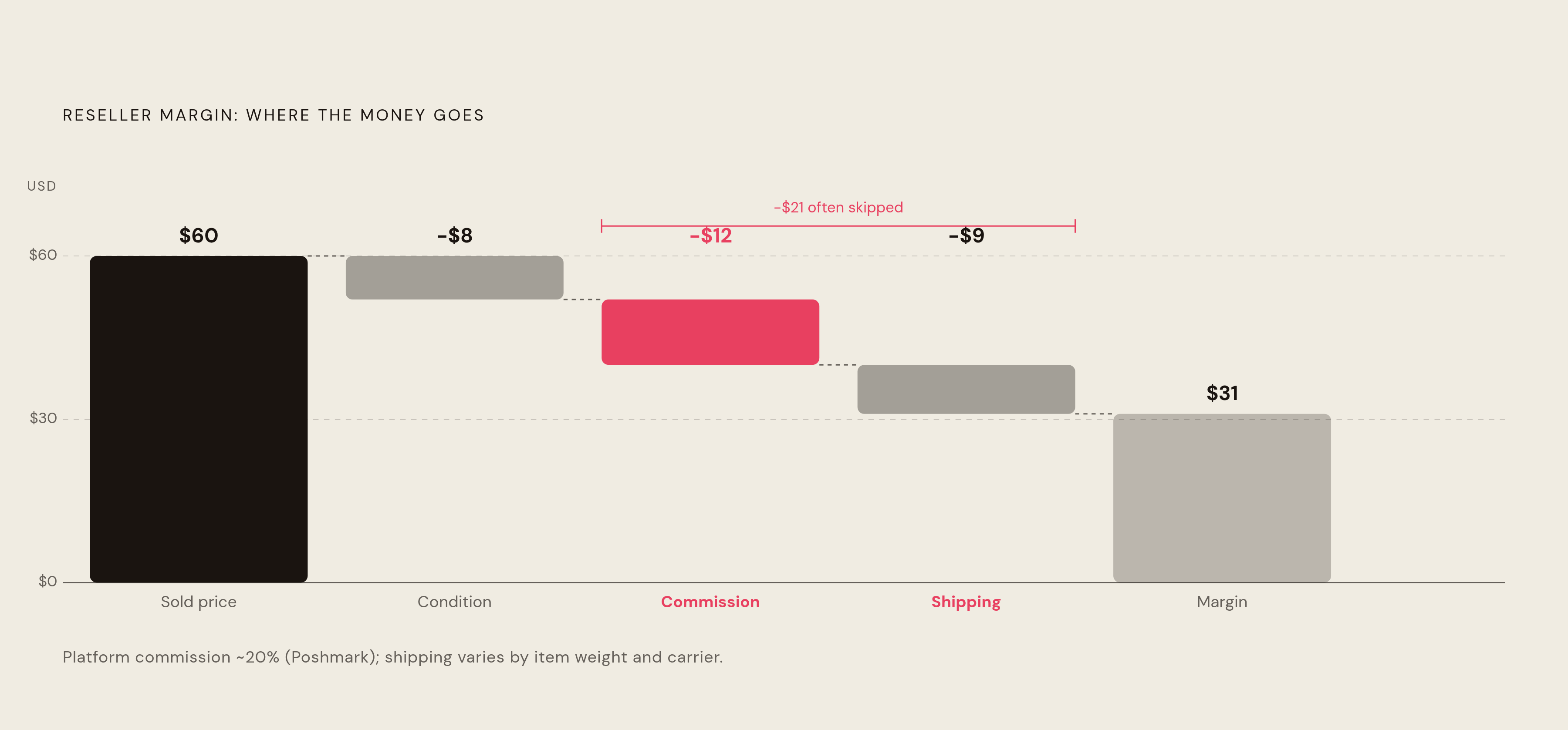
The final calculation discounts meaningfully from mint-condition comparisons for flaws and missing accessories. It then deducts marketplace commissions, packaging and shipping, with commissions around 20% on Poshmark and varying by platform. Shipping weight belongs in that calculation before checkout.
Phone-based AI scanning can shorten this work by identifying an item, pulling sold comparisons and estimating a price range in seconds, a process that takes several minutes of manual searching. That speed helps most when the sale first opens and the house is crowded, while the sought-after items are still there. It does not change the underlying decision, which still rests on demand, condition and costs.