How Buyers Evaluate Trust in Secondhand Transactions
Seller reputation and listing details determine whether secondhand buyers take the risk.

Secondhand shopping stopped being a niche hobby a while back. A 2026 recommerce trend report from ulansoftware.com found that global resale hit roughly $188 billion in 2024 and is on track for $310 billion by 2029, growing at 10 to 11% a year. OfferUp's 2025 Recommerce Report found that 93% of Americans bought something secondhand that year. At that point, people trust the specific stranger selling it to them, or they don't. It's whether they trust the specific stranger selling it to them.
That trust is built, piece by piece, before a buyer ever hits "buy." It gets built, piece by piece, before a buyer ever hits "buy." Sellers know their item's real condition; buyers only know what the listing tells them, which is a textbook case of what economists call information asymmetry. Research on marketplace design (published in the Chicago Journals) shows online markets can't function without trust, because buyers need to believe the listing is accurate and sellers need to believe payment is coming. Throw in machine-generated listings, sellers shipping from three time zones away, and scams that have gotten a lot more convincing, and buyer caution in 2025 and 2026 has gone up accordingly. Multivendorx.com's marketplace trust framework finds a polished-looking marketplace no longer earns automatic trust. So here's the walkthrough: which signals actually move a buyer from browsing to buying, why each one works, and what a seller can do about it.
How buyers sort sellers before reading the listing
Before anyone reads a description, they're sizing up the person selling it. Profile completeness, verification badges, account age, transaction count, that's the first scan.
Everyone looks great on paper. Research using an eBay dataset found the median seller is at 100% positive feedback, and even the seller at the low end of the distribution, worse than the vast majority of sellers, is still at 98.21% positive. When scores are bunched that tight, a perfect rating tells a buyer almost nothing. It's table stakes, not a differentiator. What buyers actually lean on once everyone looks equally spotless is everything else: how fast someone responds, how complete the listing is, the tone of the messages.
Platforms with a social layer get a shortcut here. Facebook Marketplace lets a buyer glance at mutual friends and community history, a built-in verification layer that platforms without a social graph simply can't fake. At a basic level, valtorian.com's 2026 marketplace trust guide points to verified email, verified phone, a filled-out profile, and a "verified" badge that was actually earned as the identity signals that matter. That same logic applies just as well to individual sellers: every verification signal shown should be one that was actually earned.
Treat your profile like it's the first listing a buyer reads, because functionally, it is. A real photo, a name or handle that isn't just numbers, a short bio, a completed verification step. All of it shrinks the distance between "stranger on the internet" and "person I'd hand $200 to."
What photos communicate beyond showing the item
Photos do two jobs at once. They show the couch, the sneakers, the camera lens, and they tell the buyer something about the person who took them. Closo.co's 2025 resale trends analysis found that listings with detailed, high-quality images build more trust and simply sell more often.
What's a buyer actually reading in a photo, beyond the object itself? A clean, well-lit background says someone took the time. A blurry photo shot in a dim hallway says the opposite, regardless of fairness. Buyers also check for completeness, wanting every angle covered, the box included, and the charger or the strap or the manual sitting in frame.
Oddly enough, photos of flaws build trust rather than kill it. A scuff, a loose button, a scratched corner, shown clearly instead of cropped out, tells the buyer this person isn't hiding anything. That's the opposite of what most sellers assume. For electronics and luxury goods especially, a photo of the original receipt or a visible serial number adds a layer of proof that's hard to fake.
Stock photos are the tell that separates careful sellers from lazy ones. A manufacturer's image says nothing about the actual condition of the actual unit a buyer would receive, and buyers have learned to be suspicious of listings that lean on them. More photos, not fewer. Flaws documented in the frame, not buried three lines down in a description nobody reads closely.
The written description as a trust document
Valtorian.com's trust framework calls out "transparent listings" as a non-negotiable: structured fields, plain condition language, a clear list of what's included, visible return terms. Ambiguity is what generates disputes, and disputes are what kill a seller's reputation and a buyer's willingness to come back. That's a lesson from marketplace design at the platform level, but it applies just as directly to a single listing written on a Tuesday night.
A transparent description does a few specific things. It states condition in real language ("light scratches on the back panel, fully functional") instead of leaning on a vague dropdown label like "good condition," which means nothing without context. It spells out what's in the box and what isn't. It mentions where the item came from when that's relevant: bought new, received as a gift, used daily for two years. Buyers weigh that history more than sellers tend to expect. And it states the return policy outright, even if the policy is simply "no returns." Silence on that question doesn't read as neutral. It reads as evasive.
Closo.co also flags certificates of authenticity as a specific trust builder for collectibles and luxury goods; if one exists, say so in the text, don't make the buyer ask.
There's a wrinkle unique to this moment: AI-written listings have gotten so common and so polished that buyers have started reading generic, too-smooth copy as a red flag rather than a plus. A description that could describe any item on the platform reads as hollow. Specific, slightly rough language about the actual object in front of the seller reads as real. A description a buyer doesn't have to decode is itself a trust signal. Friction in reading turns straight into hesitation about buying.
How pricing signals honesty as much as value
The price a seller sets says as much about them as the item does. The most common mistake buyers can spot from a mile away is pricing based on what other people are asking, rather than what similar items have actually sold for. Anyone can list a laptop at whatever price they like. What matters is whether that asking price lines up with what that laptop actually traded for last month.
Active listings are hope. Sold listings are data. That distinction matters because a buyer can check eBay's sold filter in about ten seconds, and a price that's out of line with recent sales reads as either the seller doesn't know the market or the seller is hoping the buyer doesn't. Neither is a good look. A rough rule buyers seem to apply: a gently used item priced near a large chunk of its original retail cost gets extra scrutiny, while one priced clearly under retail signals a seller who understands where their item actually sits.
Even the shape of the number matters. A price like $45 or $120 reads as intentional, like someone thought about it. A price like $43.67 reads like a spreadsheet formula spit it out, or like the seller wasn't sure and split the difference. Buyers trust the round, confident number more.
On platforms with Best Offer, pricing a bit above target and accepting reasonable counters signals flexibility and good faith. Sitting on a stale listing and rejecting every offer signals rigidity, and it makes buyers wonder what else this person won't budge on. This is exactly where pricing tools that pull real sold-comp data earn their keep: a defensible, data-backed price removes the guesswork that makes both overpriced and underpriced listings look suspicious in the first place.
How a seller's response to a buyer's message shapes the transaction
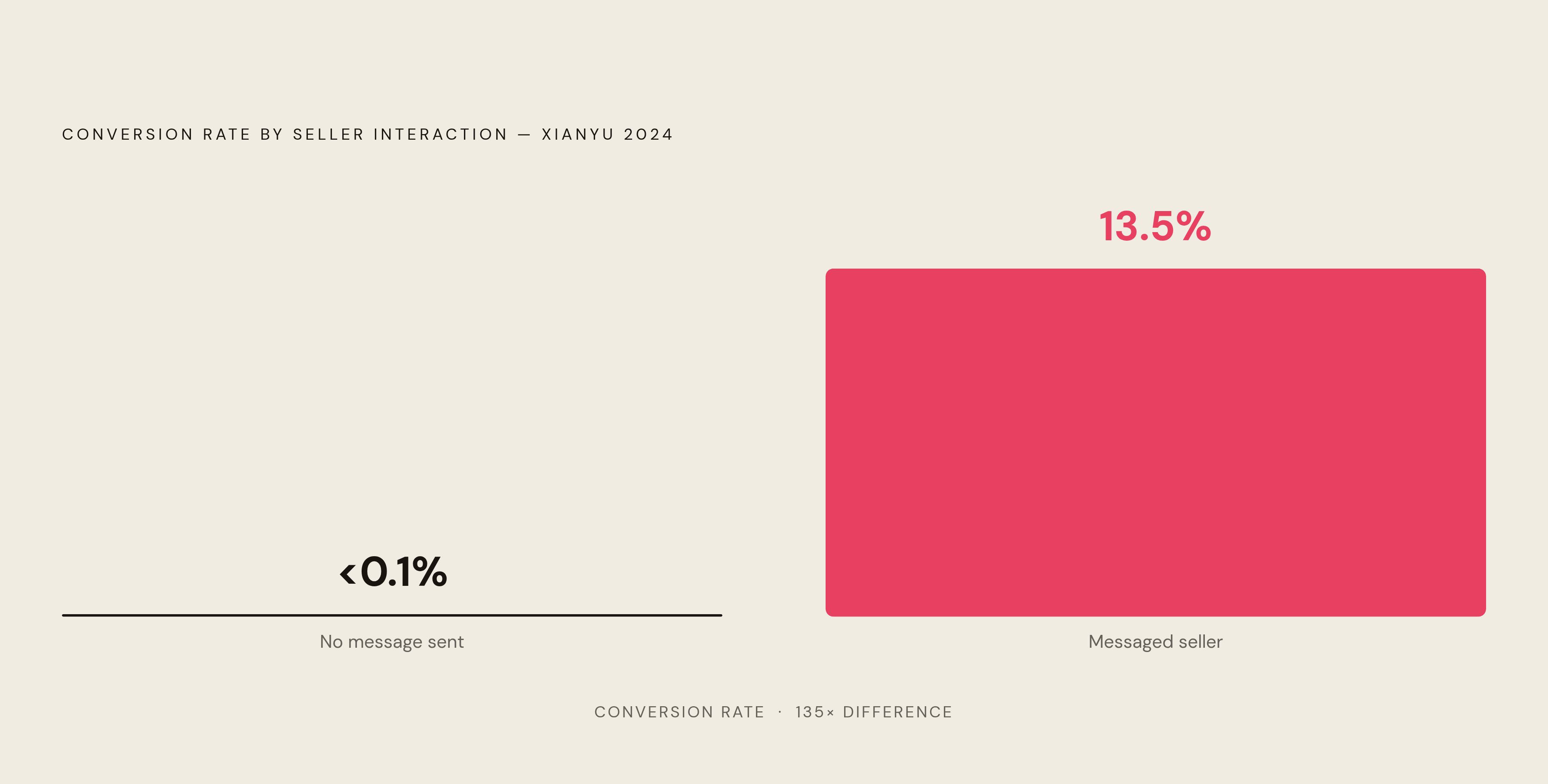
Messaging isn't a nice-to-have. On Xianyu, China's largest C2C resale platform with 120 million monthly active users in 2024, buyers who interact with a seller convert at 13.5%. Buyers who don't interact at all convert at under 0.1%, compared with 13.5% for those who interact. That's a gap large enough to separate a sale from dead inventory. That's the difference between a sale and dead inventory.
Facebook Marketplace runs on the same logic in a more visible way: buyers routinely message multiple sellers about nearly identical items, and a fast reply is often what separates a sale from a pass. The consistent advice across seller guides is blunt: turn notifications on and answer within hours, not days.
What's actually being judged in that reply isn't just the answer, it's everything around it. Speed says there's a real, active person on the other end. Specificity, an actual answer to the actual question instead of a copy-pasted "yes it's available," says the seller knows their own item. Volunteering something the buyer didn't even ask about, another photo, a clarification on a scratch, signals confidence rather than something to hide. Tone that is clear and direct, without turning cold or robotic, keeps buyers from second-guessing the seller.
The messaging doesn't stop at the sale, either. Proactive shipping updates are a recognized trust builder that protects a seller's reputation well after the payment clears. A buyer who feels informed has far less reason to open a dispute out of uncertainty. Buyers have also gotten sharp at spotting scam patterns inside chat threads: requests to move the conversation off-platform, odd payment methods, sudden urgency. Staying entirely on-platform, in plain language, is what keeps a seller inside the zone buyers consider safe.
The two ways a bad transaction damages trust
A study in the Journal of Theoretical and Applied Electronic Commerce Research dug into exactly how a bad transaction damages trust, and it found the damage isn't one-size-fits-all. Using attribution theory, the researchers split harm into two distinct types.
Fulfillment harm is when the seller simply didn't deliver what was promised, wrong condition, item never showed up, missing pieces. This mostly damages trust in that one seller. Integrity harm is different: it's when the buyer believes the seller knew about a problem and hid it on purpose. That kind of harm bleeds outward and damages trust in the platform itself, not just the individual seller. And when both show up in the same transaction, the study found the damage compounds, worse than either one alone.
A fulfillment mistake is recoverable for anyone selling regularly. Handle the dispute well, and most buyers move on. A perceived intent to deceive doesn't stay contained. It follows the seller and, in aggregate, poisons how buyers see the whole platform.
Which means the description, the photos, the condition grading aren't just administrative listing tasks. They're promises. The gap between what was promised and what showed up in the box is the actual mechanism that destroys trust. A seller who discloses a flaw upfront isn't just being polite, they're closing off the possibility of ever being read as deceptive. A disclosed flaw is a fulfillment success, even when the item itself is less than perfect.
How platform protections work as a trust floor
Buyers rely on the platform to answer one question sellers can't answer themselves: what happens if this goes wrong. Valtorian.com's 2026 guide frames the buyer's checklist as three questions, who is this, why should this seller be trusted, and what happens if it goes wrong, and notes that if a marketplace can't answer that third one clearly, conversion stalls no matter how good the listing is. The seller handles the first two. The platform has to handle the third.
Different platforms answer it differently. eBay backs transactions with buyer protection programs, and a field experiment on eBay's search ranking found that folding a quality signal into how listings get ranked pushed buyers toward higher-quality sellers and increased subsequent purchasing without reducing contemporaneous conversion. Facebook Marketplace splits the difference: shipped transactions carry a 5% selling fee that covers payment processing, while local pickup is free but comes with none of that safety net, and buyers price their trust accordingly when they see which option a seller offers. As of 2026, Facebook Marketplace has also added improved seller ratings and stronger safety features to its platform.
None of that helps if a buyer doesn't know it applies. Sellers who mention tracked shipping, spell out their return policy, or reference their verified status inside the listing itself are pointing straight at the safety net, which lowers anxiety before it has a chance to build. Tracking specifically does double duty: it's a logistics tool and a trust signal at once. A buyer watching a package move in real time has no dead air for anxiety to fill, and no reason to open a dispute out of pure uncertainty.
What sellers can do to build trust faster at the listing stage
Most sellers who skip these steps are just tired. They're just tired. Incomplete photos, vague condition notes, a price pulled out of thin air, that's usually friction winning out over effort, not an attempt to mislead anyone.
A quick trust check to run against any listing before it goes live:
- Profile: verified, filled out, real photo, transaction history a buyer can actually see
- Photos: multiple angles, natural light, flaws shown in frame, accessories included in the shot
- Description: plain-language condition, what's in the box and what isn't, provenance if it's relevant, return policy stated outright
- Price: anchored to recent sold comps rather than what other listings are asking, a round number, room to negotiate if the platform allows offers
- Messaging: notifications on, replies within hours, specific answers instead of copy-paste
- Shipping: tracked, mentioned in the listing itself, updates sent without being asked
The steps that build the most trust are also the ones that eat the most time: accurate condition grading, pricing anchored to real sold data, a description that's structured and complete. That's exactly where a tool that reads a photo and handles item identification, condition notes, and listing copy earns its place. It cuts the friction without taking the seller's judgment out of the process.
Which levels the field more than people expect. A first-time seller with accurate, data-backed pricing and an honest, complete listing competes on equal footing with someone who's sold thousands of items, because the signals that build trust aren't a personality trait or a lucky rating score. They're specific, learnable, and increasingly automatable. Each one answers a question the buyer is silently asking before they ever type a message. Get enough of those answers right, and a hesitant browser turns into someone hitting "buy now" without a second thought.
Sources
- Who Is to Blame? How Fulfillment and Integrity Harms Relate to Trust in Sellers and Platforms
- Resale Market Trends for 2025: What to Expect
- Designing Online Marketplaces: Trust and Reputation Mechanisms | Innovation Policy and the Economy: Vol 17, No null
- Marketplace Trust Features in 2026: The Must-Haves
- 8 Second-Hand Marketplace Platforms Trends: How Recommerce is evolving in 2026
- Marketplace Trust Framework: How to Build Trust and Grow Your Marketplace
- Trust, Privacy, and Safety Factors Associated with Decision Making in P2P Markets Based on Social Networks: A Case Study of Facebook Marketplace in USA and Canada | Proceedings of the 2024 CHI Conference on Human Factors in Computing Systems